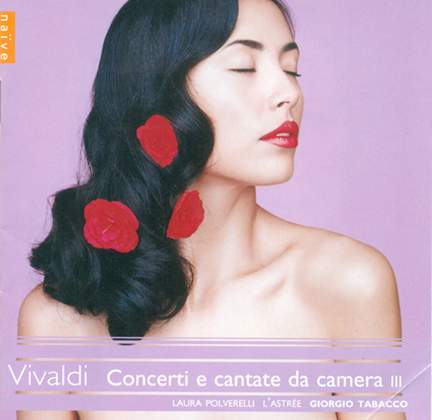
Special offer. Vivaldi - Concerti & cantate da camera III
Laura Polverelli (mezzo-soprano)
L’Astrée, Giorgio Tabacco
Polverelli is an agile singer who negotiates Vivaldi's sometimes hazardous vocal lines with technical assurance and lively responses to the texts.
Special offer. Vivaldi - Concerti & cantate da camera III
Laura Polverelli (mezzo-soprano)
L’Astrée, Giorgio Tabacco
Purchase product
Polverelli is an agile singer who negotiates Vivaldi's sometimes hazardous vocal lines with technical assurance and lively responses to the texts.
About
Contents and tracklist
- Astree, L'
- Laura Polverelli (mezzo-soprano)
- Astree, L'
- Astree, L'
- Laura Polverelli (mezzo-soprano)
- Astree, L'
- Astree, L'
- Laura Polverelli (mezzo-soprano)
- Astree, L'
Awards and reviews
 December 2005
Polverelli is an agile singer who negotiates Vivaldi's sometimes hazardous vocal lines with technical assurance and lively responses to the texts.
 2010
2010
Naïve's monumental Vivaldi series continues its sensible policy of mixing chamber cantatas and concertos in this third volume, in which Italian ensemble L'Astrée are joined by mezzosoprano Laura Polverelli. Polverelli proves an agile artist, as much she needs to be; Vivaldi, as is his wont, challenges her vocal athleticism with the kind of jagged melodic lines and rattling passagework that a kinder composer might have avoided, all in the cause of expressing what seem like the rather subtler shades of Arcadian love.
Happy to say, she triumphs. Despite having a voice whose operatic intensity, dark colouring and low centre of gravity sound at first as if they will be ill-suited to the angular music that Vivaldi- lovers will know lies ahead, when the time comes she negotiates the composer's treacherously scattered notes with languid ease. What is more, she brings a commanding sense of drama to the recitatives and uncommon dignity and moment to the arias. The cantatas themselves are worth the trouble: the two intertwining violins of Amor hai vinto ooze amorous disquiet; Lungi dal vago volto closes with a gleeful hoedown; and Vengo a voi, luci adorate sets out in a mood of modish galant but cannot escape its Vivaldian identity for long.
The instrumental support from L'Astrée is tightly solid throughout (save for a slightly acid violin in Lungi dal vago volto) and the three concertos are performed with imagination and spirit. Particularly enjoyable is RV107, where the omission of continuo leaves us with a charming (and in no way incomplete-sounding) trio of recorder, oboe and bassoon. A disc principally for Vivaldi specialists, perhaps, but newcomers who stumble across it will surely find plenty to entertain them too.