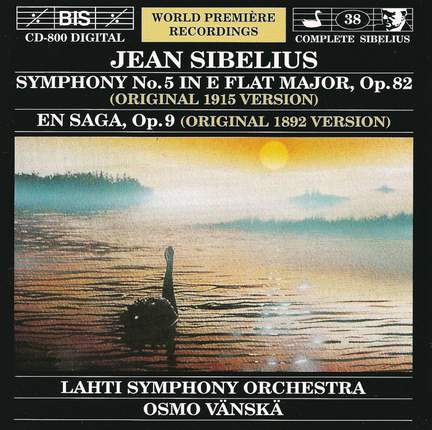
Sibelius: Symphony No. 5 & En Saga
Lahti Symphony Orchestra, Osmo Vänskä
Awards:
-
Gramophone Awards, 1996, Winner - Engineering

Every so often a CD appears which, by means of some interpretative insight, changes our view of a piece of music. This disc changes our whole perspective in a wholly different sense, for it...
Sibelius: Symphony No. 5 & En Saga
Lahti Symphony Orchestra, Osmo Vänskä
Purchase product
Awards:
-
Gramophone Awards, 1996, Winner - Engineering
Every so often a CD appears which, by means of some interpretative insight, changes our view of a piece of music. This disc changes our whole perspective in a wholly different sense, for it...
About
Contents and tracklist
Work length35:40
I. Tempo tranquillo assai
Track length8:26
II. Allegro commodo
Track length5:20
III. Andante mosso
Track length7:44
IV. Allegro commodo - Largamente molto
Track length14:10
Work length22:23
- Sinfonia Lahti
- Osmo Vänskä
Awards and reviews
 2010
2010
Every so often a CD appears which, by means of some interpretative insight, changes our view of a piece of music. This disc changes our whole perspective in a wholly different sense, for it gives us a glimpse of two familiar masterpieces in the making. Sibelius struggled with the Fifth Symphony for almost seven years from about 1912 until it reached its definitive form in 1919.
Although the finished score of the first version doesn't survive, the orchestral material does, so it was not difficult to reconstruct the score.
To study how the two scores differ is to learn something important about the creative process and it's this mystery that makes this disc imperative listening – and not just for Sibelians. The four-movement 1915 score has a more complex harmonic language than the final score and so it provides a missing link, as it were, between the Fourth Symphony and the definitive Fifth. The opening horn motive has yet to emerge, and the finale's coda has yet to acquire its hammer-blow chords. And in between you'll find that the various themes, some distinctly recognisable, others taking off in totally unexpected directions and charting unknown regions.
The version of En saga with we're familiar with doesn't come between the Kullervo Symphony and the Karelia music, but from 1901, between the First and Second Symphonies and was made for Busoni.
The original offers fascinating material for comparison: there's a brief glimpse of Bruckner, whose work he had encountered in Vienna a year or two earlier, and the orchestral writing, though not always as polished as in the later version, still has flair. Praise to the Lahti orchestra and their fine conductor, and the excellent and natural balance.