Weber: Chamber Works
The Gaudier Ensemble
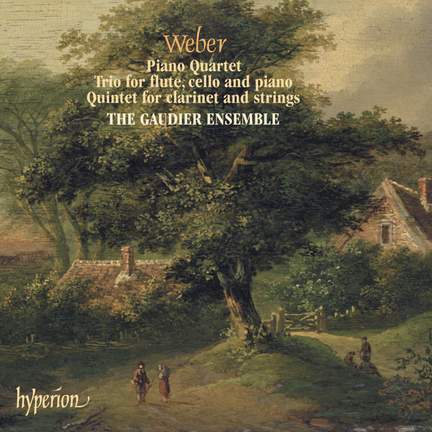
Weber's three pieces of chamber music make an attractive record, and the performances here are responsive to the works' particular problems.
With the early Piano Quartet, the young virtuoso...
Weber: Chamber Works
The Gaudier Ensemble
Purchase product
Weber's three pieces of chamber music make an attractive record, and the performances here are responsive to the works' particular problems.
With the early Piano Quartet, the young virtuoso...
About
This new recital brings together all of Webers chamber works to employ more than two musicians. Opening the disc is the famous Clarinet Quintet, presented in a performance which sparkles with joie de vivre from the off. Written for the clarinet virtuoso Heinrich Baermann (whose recent acquisition of a new-fangled ten-keyed instrument opened up exciting new technical possibilities for the composer), the work quickly established itself in the public arena, its lyrical poise encompassing more than enough pyrotechnical showmanship to guarantee rapturous applause. The Piano Quartet, written when the composer was barely out of his teens, sets a similarly ambitious challengethis is composition at the cutting edge of the Romantic tradition where all four instruments are given scope to shine within a comprehensively convention-breaking structure. The Trio for flute, cello and piano was completed in 1819, during the composition of Webers operatic masterpiece Der Freischutz. Graceful lyricism sits happily alongside impassioned intensity as the composer unites the three instrumentsperhaps unlikely bedfellowsin a whole of pleasing integrity. The Gaudier Ensemble is among the foremost of chamber ensembles, and these latest performances are every bit as thrilling as their enviable reputation would lead one to expect.
Contents and tracklist
Awards and reviews
 2010
2010
Weber's three pieces of chamber music make an attractive record, and the performances here are responsive to the works' particular problems.
With the early Piano Quartet, the young virtuoso set himself some tricky tests, especially in the matter of balance. In the complicated middle section of the Adagio, for instance, there are leaping violin phrases, forte, against soft piano chords with a viola murmuring away to itself pianissimo in the middle.
It works well here. In Susan Tomes's hands, the Trio of the Minuet has a nice waltzing lilt and the finale blazes with energy. The players are willing to take liberties: though there is no warrant for the long accelerando in the finale of the Piano Trio, it is not the kind of thing Weber would have objected to, and both the pensive opening and the brooding melancholy of the 'Shepherd's Lament' are very much in the right spirit.
Richard Hosford is excellent in the Clarinet Quintet and is given a nice, clean acoustic for all the brilliant effects. There is, however, an oddity in the Adagio with the pairs of chromatic scales: the first, 'as loud as possible', is fine, but the second, pianissimo, is so quiet as to be barely audible, sounding as if it is drawn right away from the microphone. Hosford rounds it all off sensationally in the dazzling final pages. The only regret is that the players use the version, or something near it, prepared by the son of Weber's first performer, Heinrich Baermann.
Carl Baermann claimed that this was the performing tradition but the evidence is insecure, and there is a good modern edition that comes closer to what must have been Weber's intentions.
All the same, a very enjoyable disc.