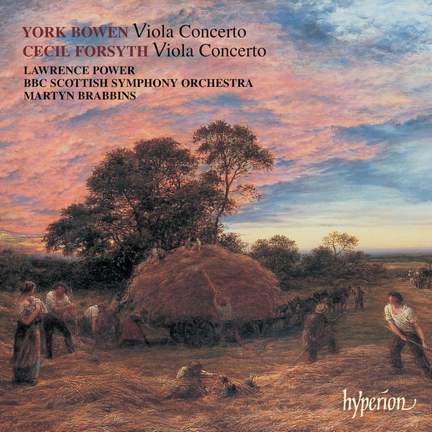
Special offer. Bowen & Forsyth - Viola Concertos
Lawrence Power (viola)
BBC Scottish Symphony Orchestra, Martyn Brabbins
Awards:
-
Gramophone Magazine, July 2005, Editor's Choice

York Bowen’s concerto is quirky and gently eccentric, full of unlikely harmonic twists and creatively stretching demands on soloist and orchestra. But the ardent and lucid Power is the real...
Special offer. Bowen & Forsyth - Viola Concertos
Lawrence Power (viola)
BBC Scottish Symphony Orchestra, Martyn Brabbins
Purchase product
Awards:
-
Gramophone Magazine, July 2005, Editor's Choice
York Bowen’s concerto is quirky and gently eccentric, full of unlikely harmonic twists and creatively stretching demands on soloist and orchestra. But the ardent and lucid Power is the real...
About
Lawrence Power is fast emerging as the foremost viola player of a new generation, the lyrical drama and versatility of his performances winning invitations to perform as soloist with top orchestras worldwide and with such chamber groups as The Nash Ensemble and the Leopold String Trio. This significant new recording presents two viola concertos whose relative obscurity belies their cultural significance and musical worth. York Bowen was born in London in 1884 and quickly emerged from his whisky-distilling family background to be recognized as a star in the musical firmament of the day. Already a competent composer and experienced concert pianist in his teens, his cause was supported by Henry Wood and Hans Richter. The viola concerto was first performed by Lionel Tertis in 1908 at The Queens Hall and is a substantial work. Moments of extreme virtuosity for the soloist (Tertis would doubtless have insisted) are supported by a full orchestral texture throughout in a work of astonishing maturity for a composer so young. Also born in London, though some two decades earlier, Cecil Forsyth had an equally impressive early career before a move to America and into the world of music publishing allowed his compositions to fall out of the repertory. The viola concerto was first performed at the 1903 Proms by mile Frir and from its very opening is marked out by an extraordinary lyricism of singing lines in the solo part. Powerful melodies are constantly thrown between viola and orchestra, and the whole gives an impression of tireless good humour. Inexplicably, the existence of the work was totally ignored by Tertis who omits any reference to it from his catalogue of English viola concertos, this despite the fact that he is known to have played in the orchestra at the premiere. Though not as soloist
Contents and tracklist
Awards and reviews
-
Gramophone MagazineJuly 2005Editor's Choice

York Bowen’s concerto is quirky and gently eccentric, full of unlikely harmonic twists and creatively stretching demands on soloist and orchestra. But the ardent and lucid Power is the real star of the disc
 2010
2010
During the decade leading up to the First World War, York Bowen, one of the brightest and most prolific young talents in British music, produced no fewer than three piano concertos, two symphonies, a concert overture, Symphonic Fantasia, Concertstücke for piano and orchestra and a tone-poem, The Lament of Tasso. His exquisitely polished and sure-footed Viola Concerto in C minor was written for Lionel Tertis (viola professor at the Royal Academy of Music), who first performed it in March 1908. Lasting nearly 36 minutes, each of its three movements serves up a heady flow of intoxicating melody, all clothed in the deftest orchestral garb (there's a definite Russian tang to proceedings – Bowen clearly knew and loved his Tchaikovsky, Borodin and Rimsky-Korsakov). This new performance is beyond criticism. Not only does Lawrence Power effortlessly surmount every technical challenge, he forms a scintillating parternship with Martyn Brabbins and an uncommonly well-prepared BBC Scottish SO.
A pupil of Stanford, Greenwich-born Cecil Forsyth (1870-1941) played the viola in Henry Wood's Queen's Hall Orchestra (as, indeed, did Bowen) before emigrating to the USA in 1914.
His G minor Concerto (in all likelihood the first for viola by a British composer) was premiered in 1903 by the French virtuoso (and its dedicatee) Emile Férir. Beside its its present companion it strikes a rather more conventional note, but remains an appealingly lyrical and sturdily crafted achievement. The performance is everything one could desire, and the recording is wonderfully ripe and glowing.

Power blows clean out of the water any preconceptions of the viola being some kind of lumbering violin. His effortless technical dexterity and cleanfocused sound throughout the range (his upper notes are simply glorious) are also straight out of the Primrose copy-book. Even in a world
overflowing with string players who can seemingly play anything at the drop of a hat, Power has that extra charismatic dimension which has the listener hanging on to his every note