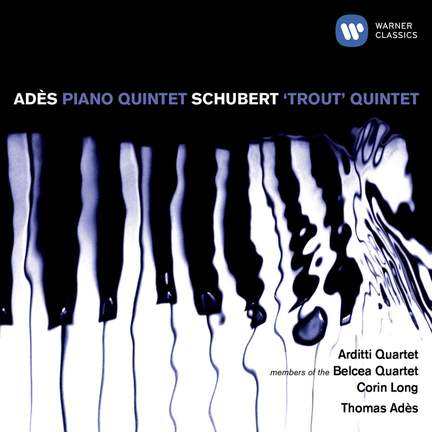
Adès: Piano Quintet, etc.
Thomas Adès (piano) & Corin Long (Double Bass)
Arditti Quartet
Awards:
-
Gramophone Magazine, August 2005, Editor's Choice

Thomas Adès features both as composer and pianist on this release: two piano quintets which, though composed 182 years apart, are equally alive with formal and expressive provocations.
That...
Adès: Piano Quintet, etc.
Thomas Adès (piano) & Corin Long (Double Bass)
Arditti Quartet
Purchase product
Awards:
-
Gramophone Magazine, August 2005, Editor's Choice
Thomas Adès features both as composer and pianist on this release: two piano quintets which, though composed 182 years apart, are equally alive with formal and expressive provocations.
That...
About
Contents and tracklist
- Arditti Quartet (performed by), Thomas Adès (piano)
- Recorded: 2002-07-04
- Recording Venue: 3 & 4 July 2002. Snape Maltings, Suffolk.
1
Track length12:03
This track is only available as an album download.
Work length41:10
This work is only available as an album download.
- Thomas Adès (piano)
- Belcea Quartet
- Recorded: 2004-09-09
- Recording Venue: 8 & 9 September 2004. Potton Hall, Suffolk.
I Allegro vivace
Track length12:16
This track is only available as an album download.
Awards and reviews
-
Gramophone MagazineAugust 2005Editor's Choice
 2010
2010
Thomas Adès features both as composer and pianist on this release: two piano quintets which, though composed 182 years apart, are equally alive with formal and expressive provocations.
That said, expression per se is not really an issue in Adès's Piano Quintet (2001). The single movement places its sonata-form emphasis so the near-literal repeat of an already evolving exposition takes on a strongly developmental feel, with the development then assuming the guise of a varied reprise, and the brief recapitulation becoming almost a transition that anticipates the coda.
It all amounts to an intriguing rethink of an age-old medium, though one whose musical material is so geared up to the unfolding of the formal process as to evince little intrinsic memorability beyond the pervasive opening motif.
Adès and the Ardittis ensure a reading of unremitting clarity, with perhaps a didactic element such as seems more than appropriate to the work itself.
Outwardly, nothing could be less didactic than the near-effortless spontaneity of Schubert's Trout Quintet – though its often unpredictable formal transitions confirm the benign influence of Haydn and early Beethoven, while its taciturn tonal progressions anticipate the composer's instrumental works of the 1820s. These are qualities to which Adès and the Belcea Quartet are responsive: listen to the hushed intensity going into the codetta of the first movement's exposition, the tellingly unquiet repose which opens the Andante's second half, or the lucidly drawn contrast between the last two variations of the fourth movement – making the return of Die Forelle itself the more arresting.
As an overall reading, it lacks the unforced naturalness of Clifford Curzon and members of the Vienna Octet, or the sense of discovery which Alfred Brendel et al manage to convey with an even greater communicative zeal. Recorded sound, with the instrumental interplay palpably defined if lacking the final degree of spatial depth, is well suited to the interpretative stance that these performances bracingly convey.