Dufay: Mass for St Anthony Abbot
The Binchois Consort, Andrew Kirkman
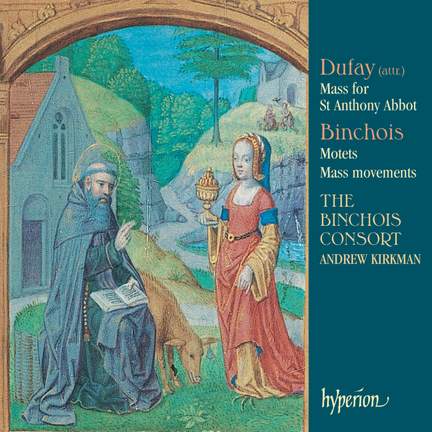
The Binchois Consort finally turn their attentions to the composer whose name they bear.
The contrast between Dufay and Binchois is every bit as striking in sacred music as in the secular. Binchois's...
Dufay: Mass for St Anthony Abbot
The Binchois Consort, Andrew Kirkman
Purchase product
The Binchois Consort finally turn their attentions to the composer whose name they bear.
The contrast between Dufay and Binchois is every bit as striking in sacred music as in the secular. Binchois's...
About
The Binchois Consort and Andrew Kirkman are now recognized as being the foremost interpreters of music by the father of polyphony that is Guillaume Dufay; their recordings of the Missa Puisque je vis and of Music for St Anthony of Padua were warmly received around the world, while the programme Music for St James the Greater won a Gramophone award. This new disc addresses the second of Dufays Anthony Masses, the one in honour of St Anthony Abbott. This is thought to be the long-lost, and long-sought, work known to have been bequeathed by Dufay to the great cathedral at Cambrai, always his spiritual home however far afield his astonishing international career took him. Alongside Dufays masterpiece this disc offers three Mass movements and two motets by Dufays great contemporary Gilles Binchois. Primarily known as a composers of secular songs, Binchois large corpus of sacred music is gradually being unearthedand meeting with the approbation it surely deserves. The eponymous composer would surely be grateful for these new performances.
Contents and tracklist
Awards and reviews
 2010
2010
The Binchois Consort finally turn their attentions to the composer whose name they bear.
The contrast between Dufay and Binchois is every bit as striking in sacred music as in the secular. Binchois's Mass movements trip along very un-solemnly, a worthy foil to the stately Dufay; but the high-point is his single surviving isorhythmic motet, here seamlessly reconstructed by Philip Weller.
It is fascinating to hear a familiar voice like Binchois's speaking in a language one's not used to from him. If the tempo chosen for the piece stretches the singers more than usually (albeit exhilaratingly), in the rest of the Dufay programme they are masterful. The verse of the Offertory has one of those spine-tingling moments (a high countertenor f'' conjured out of nowhere) that hits the bull's eye every time you hear it.