Special offer. Allegri: Miserere mei, Deus, etc.
A Sei Voci, Bernard Fabre-Garrus
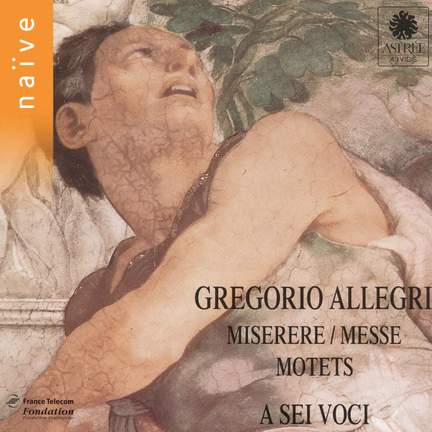
Allegri's setting of the psalm Miserere mei is presented in two versions. The first is sung with ornamentation added by the French musicologist Jean Lionnet following 17th-century models, while...
Special offer. Allegri: Miserere mei, Deus, etc.
A Sei Voci, Bernard Fabre-Garrus
Purchase product
Allegri's setting of the psalm Miserere mei is presented in two versions. The first is sung with ornamentation added by the French musicologist Jean Lionnet following 17th-century models, while...
About
Contents and tracklist
Awards and reviews
 2010
2010
Allegri's setting of the psalm Miserere mei is presented in two versions. The first is sung with ornamentation added by the French musicologist Jean Lionnet following 17th-century models, while the second presents the Burney-Alfieri version familiar from the classic 1963 Willcocks recording above. A Sei Voci produce a rather varied sound, which is at times somewhat flat and white but at its best is embued with an appropriate Italianate edge. For the most part the embellishments are negotiated with style and verve; just occasionally they're fuzzy or insecure. Misereremei apart, hardly any of Allegri's music is heard either liturgically or in the concert hall. By training a pupil of Nanino, a distinguished follower of Palestrina, his best music is written confidently in the High Renaissance contrapuntal manner. The six-voice MissaVidi turbam magnam, composed on one of his own motets, is a fine work, and shows that the stile antico, far from being a mere academic exercise, could still be vividly sonorous and dramatic, qualities which are brought out in this reading. The disc is nicely rounded out with a selection of short continuo motets in the popular new manner, well established in Northern Italy, which was becoming fashionable in Rome.