Special offer. Handel: Alexander's Feast
Nancy Argenta, Ian Partridge, Michael George
The Sixteen, The Symphony of Harmony and Invention, Harry Christophers
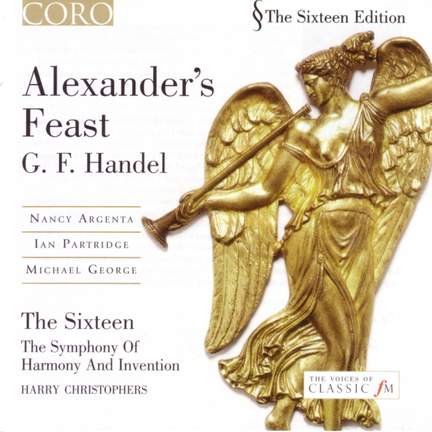
Handel's 1736 setting of Dryden's ode is heard here with two interpolations made in the first performance - a concerto for harp and one for organ. Harry Christophers's feeling for sonority...
Special offer. Handel: Alexander's Feast
Nancy Argenta, Ian Partridge, Michael George
The Sixteen, The Symphony of Harmony and Invention, Harry Christophers
Purchase product
Handel's 1736 setting of Dryden's ode is heard here with two interpolations made in the first performance - a concerto for harp and one for organ. Harry Christophers's feeling for sonority...
About
Contents and tracklist
- Ian Partridge, Andrew Lawrence-King, Stephen Stubbs, Erin Headley, Nancy Argenta, Michael George, Paul Nicholson
- The Sixteen
- Harry Christophers
Harp Concerto Op.4, No.6 in B Flat: III - Allegro Moderato: Handel: Alexander's Feast
Track length2:42
Awards and reviews
 June 2005
Handel's 1736 setting of Dryden's ode is heard here with two interpolations made in the first performance - a concerto for harp and one for organ. Harry Christophers's feeling for sonority is much in evidence, and the vocal soloists are excellent.
 2010
2010
Alexander's Feast, an ode to St Cecilia by the longdead John Dryden, was set by Handel in 1736 and revised many times. Subtitled 'The Power of Musick', it describes a banquet held by Alexander the Great after his victory over the Persians. The singing and playing of Timotheus inspire Alexander to drunkenness, pity, love and revenge, one after the other. What has this to do with the patron saint of music, you might well ask? The answer comes in a commentary towards the end, when Dryden contrasts Timotheus's pagan skills with the invention of the organ and the celestial connections of 'Divine Cecilia', who 'enlarg'd the former narrow bounds'.
The music is superb, and it's given a superb performance here. The Sixteen (actually 18, with two extra sopranos and an all-male alto line) are a little lightweight in the grander choruses but they sing with precision and unforced tone. Over a swiftly moving ground bass, 'The many rend the skies' goes with a swing; their finest moment, though, is their hushed contemplation of the Persian king lying dead on the field of battle.
The lion's share of the solos goes to Nancy Argenta, whose fresh tones, admirably suited to 'War, he sung, is toil and trouble', are cunningly and effectively veiled for 'He chose a mournful muse', an accompanied recitative in the manner of 'Thy rebuke hath broken his heart'. Ian Partridge is superb in his subtle handling of the words, as he is with his wonderful breath control in 'Happy pair'. Michael George is perfect in 'Revenge, Timotheus cries': hissing snakes, flashing sparkles and all.
The orchestration is a constant delight. In some of the solo numbers Handel uses only violins and continuo; elsewhere he introduces a solo cello, a trumpet obbligato, recorders and horns. Best of all is the creepy middle section of 'Revenge, Timotheus cries', where he conjures up the 'ghastly band' of the Grecian dead with Neapolitan sixth cadences played by the violas and bassoons in octaves. All these opportunities are seized with relish by the Symphony of Harmony and Invention.
In an unsuitable church acoustic, Harry Christophers sets unfailingly suitable tempi. And to add to our delight he includes the concerti detailed above that are integral to the piece.