Special offer. American Classics - Henry Cowell
A Continuum Portrait - 2
Continuum: Ellen Lang (mezzo-soprano), Mia Wu (violin), Jayn Rosenfel (flute), Marsha Heller (oboe), Maria Kitsopoulos (cello), Cheryl Seltzer (harpsichord / piano), Joel Sachs (piano / conductor)
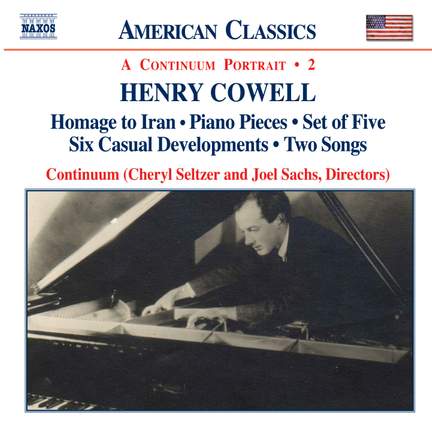
Henry Cowell was an avant-garde pioneer with his tone-clusters; became a multi-culturalist, some of whose music falls midway between East and West; and was an inspiration to younger American...
Special offer. American Classics - Henry Cowell
A Continuum Portrait - 2
Continuum: Ellen Lang (mezzo-soprano), Mia Wu (violin), Jayn Rosenfel (flute), Marsha Heller (oboe), Maria Kitsopoulos (cello), Cheryl Seltzer (harpsichord / piano), Joel Sachs (piano / conductor)
Purchase product
Henry Cowell was an avant-garde pioneer with his tone-clusters; became a multi-culturalist, some of whose music falls midway between East and West; and was an inspiration to younger American...
About
Contents and tracklist
Awards and reviews
 2010
2010
Henry Cowell was an avant-garde pioneer with his tone-clusters; became a multi-culturalist, some of whose music falls midway between East and West; and was an inspiration to younger American composers such as John Cage and Lou Harrison. His use of the insides of the piano has borne fruit in the work of George Crumb. Cowell said he wanted to 'live in the whole world of music' and wrote almost 1000 works to prove it.
Many of these are unknown but his position in the record catalogue has been improving steadily since his centenary in 1997.
Cowell recorded three of the group of four piano pieces on the first CD in 1962; his aggressive Tiger is better phrased and slower than Joel Sachs's and thus more comprehensible but DeepColor is barely known. Both the Suite for Violin and Piano (1925) and the much later Quartet for flute, oboe, cello and harpsichord are neo- Baroque. The Bach-with-clusters approach at first seems surreal but the Andante calmato is magical. Polyphonica is a bracing study in the kind of dissonant textures fashionable in the late 1920s but the Irish Suite is quite different. It's an expanded version for piano and small orchestra of three earlier pieces played directly on the piano strings. The first is Banshee (the original version is on the second CD) named after the ghost which wails at the time of a death.
The ravishing new sounds in all three pieces – amazing for 1929 – are uniquely Cowell's.
In 1956 he spent some time in the Middle East; one result was the Homage to Iran for violin, piano and drums. As elsewhere, he ingeniously adapts ethnic materials in a manner that falls midway between the two cultures. The Six Casual Developments (1933) for clarinet and piano are vivid epigrammatic miniatures. The Set of Five (1952) is for violin, piano and varied percussion, used to provide an ethnic flavour. The final vigoroso is spacious and declamatory with a surprise in the middle – a duet for celesta and prepared piano.
These two CDs provide a judiciously chosen sample of Cowell's work on a small scale; the performances are fine; enthusiasts for Cowell will certainly want both.