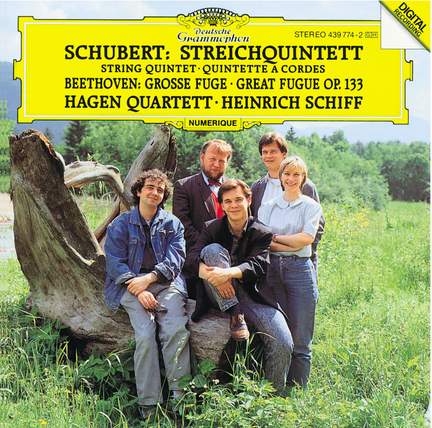
Schubert: String Quintet in C major, D956, etc.
with Heinrich Schiff (cello)
Hagen Quartett
Awards:
-
Building a Library, October 2007, First Choice

By following Boccherini in using two cellos instead of two violas for his String Quintet, Schubert increased the potential for greater textural contrast. Moreover, the dichotomy between the...
Schubert: String Quintet in C major, D956, etc.
with Heinrich Schiff (cello)
Hagen Quartett
Purchase product
Awards:
-
Building a Library, October 2007, First Choice
By following Boccherini in using two cellos instead of two violas for his String Quintet, Schubert increased the potential for greater textural contrast. Moreover, the dichotomy between the...
About
Contents and tracklist
- Heinrich Schiff (cello)
- Hagen Quartett
- Recorded: 1991-07
- Recording Venue: Kirche St. Konrad, Abersee
- Hagen Quartett (stringquartet)
- Recorded: 1993-04
- Recording Venue: Residenz, Max-Joseph-Saal, Munich
Awards and reviews
 2010
2010
By following Boccherini in using two cellos instead of two violas for his String Quintet, Schubert increased the potential for greater textural contrast. Moreover, the dichotomy between the tragic perspective and Viennese gaiety in the Quintet, so evident in much of Schubert's greatest music, generates an especially potent dramatic force.
The Hagen Quartet's performance of the first movement, which presents remarkably clear textural detail, is broad and expansive. The Hagen include the exposition repeat in a movement that lasts almost 20 minutes. Perhaps as a consequence, they play the Adagio second movement at an unusually fast tempo. However, through breathtaking dynamic control in the first section, passionate intensity in the second, and engaging spontaneity of the ornamentation in the final section, the Hagen achieve an expression that's powerfully compelling.
The second half of the Quintet is often treated as a period of emotional relief from the profound concentration of the first two movements.
Startlingly, the Hagen maintain the tension with violent textural and dynamic contrast in the Scherzo, and distinctively varied registral sonority in the Trio. The finale, in which the Hagen effectively balance the music's charming Hungarian flavour with its more sinister touches, provides an arresting conclusion The Hagen's account of Beethoven's GrosseFuge is polished and sensitive and it vividly conveys the difference between Beethoven's and Schubert's compositional means. The Hagen's is an outstanding disc, in which exceptional performances, that challenge the finest alternatives, are complemented by superb recording.