Special offer. Copland: Chamber Works
Martin Roscoe (piano), Michael Collins (clarinet)
The Vanbrugh Quartet
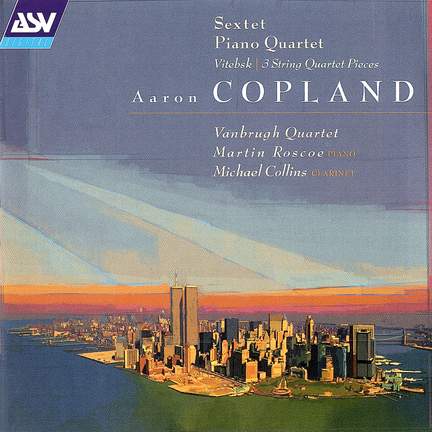
This fine collection of Copland's small output of chamber music offers the first British recording of Movement, a characteristically introspective piece from his student years in Paris which...
Special offer. Copland: Chamber Works
Martin Roscoe (piano), Michael Collins (clarinet)
The Vanbrugh Quartet
Purchase product
This fine collection of Copland's small output of chamber music offers the first British recording of Movement, a characteristically introspective piece from his student years in Paris which...
About
Contents and tracklist
Work length6:31
- Gregory Ellis (violin), Keith Pascoe (violin), Simon Aspell (viola), Christopher Marwood (cello)
- Vanbrugh Quartet
- Recorded: 1999-04-15
- Recording Venue: Potton Hall, Dunwich, Suffolk
Work length8:55
- Gregory Ellis (violin), Keith Pascoe (violin), Simon Aspell (viola), Christopher Marwood (cello)
- Vanbrugh Quartet
- Recorded: 1999-04-15
- Recording Venue: Potton Hall, Dunwich, Suffolk
No. 1: Lento molto
Track length5:19
No. 2: Allegro moderato
Track length3:36
Work length11:18
- Martin Roscoe (piano), Gregory Ellis (violin), Keith Pascoe (violin), Simon Aspell (viola), Christopher Marwood (cello)
- Vanbrugh Quartet
- Recorded: 1999-04-15
- Recording Venue: Potton Hall, Dunwich, Suffolk
Work length21:43
- Martin Roscoe (piano), Gregory Ellis (violin), Keith Pascoe (violin), Simon Aspell (viola), Christopher Marwood (cello)
- Vanbrugh Quartet
- Recorded: 1999-04-15
- Recording Venue: Potton Hall, Dunwich, Suffolk
1. Adagio serio
Track length6:38
2. Allegro giusto
Track length7:50
3. Non troppo lento
Track length7:15
Work length15:08
- Michael Collins (clarinet), Martin Roscoe (piano), Gregory Ellis (violin), Keith Pascoe (violin), Simon Aspell (viola), Christopher Marwood (cello)
- Vanbrugh Quartet
- Recorded: 1999-04-15
- Recording Venue: Potton Hall, Dunwich, Suffolk
1. Allegro vivace -
Track length4:13
2. Lento -
Track length5:34
3. Finale. Precise and rhythmic
Track length5:21
Awards and reviews
 2010
2010
This fine collection of Copland's small output of chamber music offers the first British recording of Movement, a characteristically introspective piece from his student years in Paris which shares a theme with the Symphony for Organand Orchestra. The Two Pieces (1928) are also rarities well worth having, the rapid second one embodying to perfection the ideals of Nadia Boulanger's teaching.
Then there are the three major chamber works, starting with Vitebsk, the 1929 trio based on a Jewish folk theme. This is a commanding performance, which makes the most of the off-key quarter- tones and is thoroughly adroit in the central Allegro. The Sextet is a genuine chamber piece, although it was an arrangement of the Short Symphony which was found too difficult for most orchestras in 1933 and had to wait until 1944 for its American premiere. With Collins and Roscoe the Vanbrugh give an accomplished performance of the Sextet's sparklingly affirmative rhythms.
The Piano Quartet (1950) is in the same slowquick- slow layout as Vitebsk. Like the final slow movement of the Piano Sonata its outer movements have a sublime immobility. Written while Copland was working on his great cycle, TwelvePoems of Emily Dickinson, the first two movements of this impressive quartet enter new territory, Copland tentatively exploring serial techniques. A few exposed string phrases lack finesse, and some soft details in the piano are almost lost – at the end of the first movement and more seriously at the end of the last movement when the dissonant note in the last chord is inaudible. But this is a valuable collection, well worth acquiring to have all these works together, played – and recorded – like this.