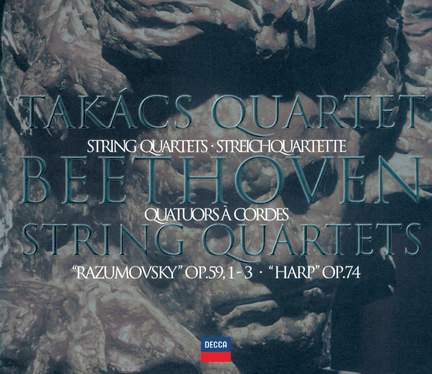
Beethoven - The Middle Quartets
Takács Quartet
Awards:
-
Building a Library, September 2002, First Choice

-
Gramophone Awards, 2002, Winner - Chamber

-
Gramophone Magazine, July 2002, Editor's Choice

-
Grammy Awards, 45th Awards (2002), Best Chamber Music Recording

The Takács do a fine job here: controlled, well paced and impeccably balanced.
They manage to balance the music's vertical and horizontal aspects beautifully, long-breathed contrapuntal lines...
Beethoven - The Middle Quartets
Takács Quartet
Purchase product
Awards:
-
Building a Library, September 2002, First Choice
-
Gramophone Awards, 2002, Winner - Chamber
-
Gramophone Magazine, July 2002, Editor's Choice
-
Grammy Awards, 45th Awards (2002), Best Chamber Music Recording
The Takács do a fine job here: controlled, well paced and impeccably balanced.
They manage to balance the music's vertical and horizontal aspects beautifully, long-breathed contrapuntal lines...
About
Contents and tracklist
- Edward Dusinberre (violin), Károly Schranz (violin), Roger Tapping (viola), András Fejér (cello)
- Takács Quartet
- Recorded: 2001-11-22
- Recording Venue: St. George's Hall, Bristol
- Edward Dusinberre (violin), Károly Schranz (violin), Roger Tapping (viola), András Fejér (cello)
- Takács Quartet
- Recorded: 2001-11-22
- Recording Venue: St. George's Hall, Bristol
- Edward Dusinberre (violin), Károly Schranz (violin), Roger Tapping (viola), András Fejér (cello)
- Takács Quartet
- Recorded: 2001-07-19
- Recording Venue: St. George's, Bristol
- Edward Dusinberre (violin), Károly Schranz (violin), Roger Tapping (viola), András Fejér (cello)
- Takács Quartet
- Recorded: 2001-07-19
- Recording Venue: St. George's, Bristol
Awards and reviews
-
Gramophone MagazineJuly 2002Editor's Choice
 2010
2010
The Takács do a fine job here: controlled, well paced and impeccably balanced.
They manage to balance the music's vertical and horizontal aspects beautifully, long-breathed contrapuntal lines gliding serenely above a sharp, occasionally dramatic accompaniment – masterful playing indeed and typical of this first lap of the Takács' projected Beethoven cycle.
The Takács hold both line and rhythm in Op 59 No 1 with imposing control. Their manner of badinage in the mischievously hocketing second movement is more intense than the rival account by The Lindsays, and their tempos consistently swifter. In Op 59 No 3 the Takács approximate the Busch in a broad, soulful Andante con moto. And in the fugal finale they're almost on a par with the Emersons, whose demonic DG account is one of the most viscerally exciting quartet recordings around. The finale of Op 59 No 2 is a tautly braced canter whereas in the Scherzo of the Harp, Op 74, taken at a hair-raising lick, the Takács make obsessive music of the dominating four-note idea – and there's absolutely no let up in tension for the cello-led trio. Indeed, the Takács' Harp is one of the finest ever recorded, with fiery reportage of the first movement's central development and a delightfully playful account of the finale, the 'tipsy' first variation especially.
The jewel, then, is Op 59 No 2, though you'd be hard pressed to find a rival digital set of Opp 59 and 74 that's better overall. Andrew Keener's recording (St George's, Bristol) reports a realistic 'edge' within a sympathetic acoustic. You won't find a finer quartet recording anywhere.