Beethoven: Violin Sonatas Nos. 1-10
Wolfgang Schneiderhan & Wilhelm Kempff
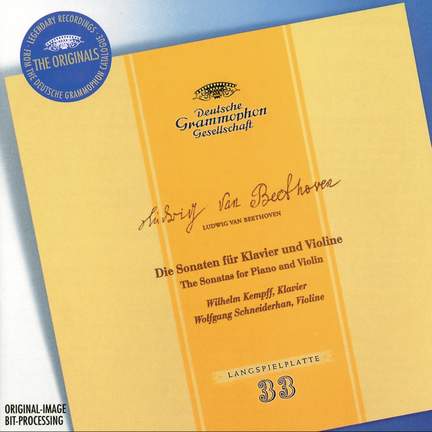
In the 1950s these recordings would have probably given a very up-to-date impression; the playing is extremely clean – there's never a hint of sentimental violin slides or over-use of the sustaining...
Beethoven: Violin Sonatas Nos. 1-10
Wolfgang Schneiderhan & Wilhelm Kempff
Purchase product
In the 1950s these recordings would have probably given a very up-to-date impression; the playing is extremely clean – there's never a hint of sentimental violin slides or over-use of the sustaining...
About
Contents and tracklist
- Wolfgang Schneiderhan (violin), Wilhelm Kempff (piano)
- Recorded: 1952-09
- Recording Venue: Mozart Saal, Konzerthaus, Vienna (Wien)
- Wolfgang Schneiderhan (violin), Wilhelm Kempff (piano)
- Recorded: 1952-09
- Recording Venue: Mozart Saal, Konzerthaus, Vienna (Wien)
- Wolfgang Schneiderhan (violin), Wilhelm Kempff (piano)
- Recorded: 1952-09
- Recording Venue: Mozart Saal, Konzerthaus, Vienna (Wien)
- Wolfgang Schneiderhan (violin), Wilhelm Kempff (piano)
- Recorded: 1952-09-20
- Recording Venue: Mozart Saal, Konzerthaus, Vienna (Wien)
- Wolfgang Schneiderhan (violin), Wilhelm Kempff (piano)
- Recorded: 1952-09
- Recording Venue: Mozart Saal, Konzerthaus, Vienna (Wien)
- Wolfgang Schneiderhan (violin), Wilhelm Kempff (piano)
- Recorded: 1952-09
- Recording Venue: Mozart Saal, Konzerthaus, Vienna (Wien)
- Wolfgang Schneiderhan (violin), Wilhelm Kempff (piano)
- Recorded: 1952-09
- Recording Venue: Mozart Saal, Konzerthaus, Vienna (Wien)
- Wolfgang Schneiderhan (violin), Wilhelm Kempff (piano)
- Recorded: 1952-09
- Recording Venue: Mozart Saal, Konzerthaus, Vienna (Wien)
- Wolfgang Schneiderhan (violin), Wilhelm Kempff (piano)
- Recorded: 1952-09
- Recording Venue: Mozart Saal, Konzerthaus, Vienna (Wien)
- Wolfgang Schneiderhan (violin), Wilhelm Kempff (piano)
- Recorded: 1952-09
- Recording Venue: Mozart Saal, Konzerthaus, Vienna (Wien)
Awards and reviews
 2010
2010
In the 1950s these recordings would have probably given a very up-to-date impression; the playing is extremely clean – there's never a hint of sentimental violin slides or over-use of the sustaining pedal. But nearly half a century later, perhaps we're more conscious of the old-world virtues – Schneiderhan's beautiful legato bowing and gentle vibrato, Kempff's full, unforced tone, and a flexible approach from both artists, with finely graded ritardandos and subtle variations of tempo.
Though not regular sonata partners, Kempff and Schneiderhan have an admirable collective sense of rhythm. They favour moderate, poised speeds, and so tend to miss something of the impulsive quality of early Beethoven. And, in the same way, their dedication to pure, well-balanced, unforced tone means that the grotesque element in such a movement as the finale of Op 30 No 2 is underplayed. It's a delight to hear them find so many ways of interpreting Beethoven's frequent sforzando markings, from sharp accents to the expressive melodic emphasis they give to the theme of the Kreutzer Sonata's variations.
But quite often Kempff downgrades or ignores these accents, smoothing away any angular corners, and this tendency towards blandness occasionally leads to disappointingly inexpressive playing, at the start of the Spring Sonata, for instance, where Schneiderhan's beautifully lyrical opening doesn't elicit a comparable response from the piano.
If there are a few let-downs, however, there are far more moments where the characteristically moderate, unexaggerated approach bears rich dividends. Schneiderhan's beautiful singing tone is a constant delight; witness the intensely vocal style of Op 24's finale and the luminous sound of his high register in the last of the Kreutzer variations. Similarly, Kempff 's continual care for clear textures and his finely balanced chordal playing seem to offer glimpses into the essence of Beethoven's thought. The mono sound is beautifully clear and well balanced.