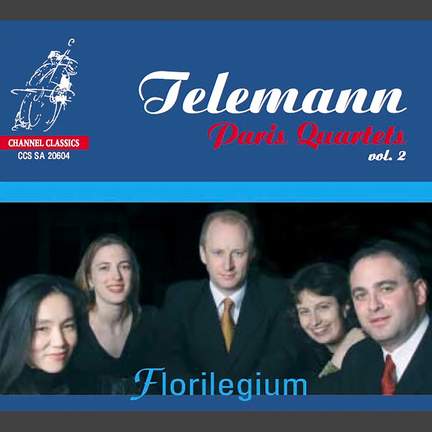
Special offer. Telemann: Paris Quartets vol. 2
Florilegium
Awards:
-
Gramophone Magazine, September 2004, Editor's Choice

Printed in Paris by Le Clerc without Telemann's permission in 1736 but composed in Hamburg in 1730, the first six of these quartets called 'Quadri' were such a success that the composer himself...
Special offer. Telemann: Paris Quartets vol. 2
Florilegium
Purchase product
Awards:
-
Gramophone Magazine, September 2004, Editor's Choice
Printed in Paris by Le Clerc without Telemann's permission in 1736 but composed in Hamburg in 1730, the first six of these quartets called 'Quadri' were such a success that the composer himself...
About
Contents and tracklist
Awards and reviews
-
Gramophone MagazineSeptember 2004Editor's Choice
 2010
2010
Printed in Paris by Le Clerc without Telemann's permission in 1736 but composed in Hamburg in 1730, the first six of these quartets called 'Quadri' were such a success that the composer himself was able to have printed – through a 'Privilege du Roi' – another six, the Nouveauxquatours en suites, in 1738. That set, too, had originated in the German city but also went down a treat with the Parisians.
Both groups are written for flute, violin, viola da gamba (with an alternative part for cello) and basso continuo, and comprise the composer's total output for this set of instruments. But confusingly, he divided 'Quadri' into pairs titled concertos, sonatas and suites; and in Concerto Primo, Florilegium use the cello while sticking with the gamba for the remaining pieces.
As before, James Johnstone is the right sort of continuo player, an inventive and expressive presence, not an intrusion. His colleagues are of a similar persuasion and their responses to both the robustness and delicacy of the music is exemplified in the first movement ('Allègrement') of the A minor quartet and second movement ('Légèrement') of the G major quartet.
These interpretations are of very high calibre.
The image is on the close side and the lines are a little crowded; a reduction in volume helps separate them and convey more clearly the nuances in the playing.
 Awards Issue 2005
…an enchanting collection… Florilegium are masterly in this repertoire and, built on the imaginative continuo work of James Johnstone, offer charming delights aplenty.