Xenakis: Choral Music
New London Chamber Choir, Critical Band, James Wood
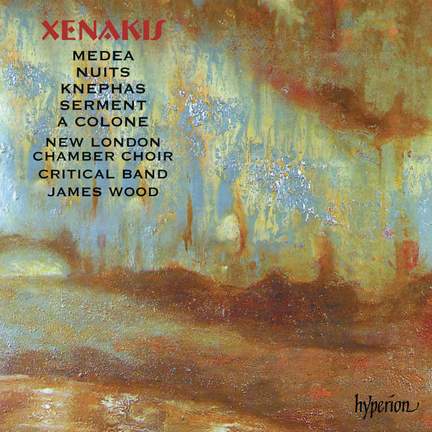
This enterprising release is a great success, showing just how varied – and unintimidating – Xenakis's music can be. The performances are nothing short of phenomenal in their technical assurance...
Xenakis: Choral Music
New London Chamber Choir, Critical Band, James Wood
Purchase product
This enterprising release is a great success, showing just how varied – and unintimidating – Xenakis's music can be. The performances are nothing short of phenomenal in their technical assurance...
About
In the oeuvre of many composers the vocal works are often the most personal, as if the primacy of the human voice and speech elicit an unguarded response. Xenakis' earliest works were based on a Bartkian approach to Greek folk music, which he rejected. However, his Greek origins continued to disturb him like subterranean tremors. His great love of ancient theatre, Greek philosophy and his mother tongue had to be married to a new musical language. The works on this CD all stem therefore from highly autobiographical sources. The works fall into three groups: the first intrumentalizes and orchestrates the voice stripped of text as in Nuits and Knephas; the second (Medea) is based on his beloved Classical Greek theatre with a dramatic context and text; and the third is a relatively new group, setting vocal texts where the language is left whole and undisturbed in a music which displays a limpid and strict modality (A Colone and Serment).
Contents and tracklist
- New London Chamber Choir, Critical Band
- James Wood
- New London Chamber Choir
- James Wood
- New London Chamber Choir
- James Wood
- New London Chamber Choir
- James Wood
- New London Chamber Choir, Critical Band
- James Wood
Awards and reviews
 2010
2010
This enterprising release is a great success, showing just how varied – and unintimidating – Xenakis's music can be. The performances are nothing short of phenomenal in their technical assurance and emotional power, and the recording is also something special, giving the singers just the right degree of space and resonance to project the often complex textures with all the necessary precision. The earliest works offer different angles on the composer's ultra-expressionist idiom, with Nuits (1967) adopting a very direct way of representing its anguished lament for the martyrs of Greece's struggle for freedom after 1945. Medea (also 1967) uses much more text, and its chant-like style has affinities with Stravinsky's Les noces, but the overall effect is much harsher, with abrasive yet imaginative instrumental writing. A Colone (1977) also has Stravinskian affinities, and the text (Sophocles's description of the delights of Colonus) prompts music which is uninhibitedly exuberant. This warmer, more celebratory side of Xenakis is carried over into Serment (1980), a short setting of a text derived from the Hippocratic Oath and not, one suspects, an entirely serious effort, though there's nothing trivial about it either. Finally, the superb Knephas ('Darkness') of 1990 begins in an appropriately unsparing manner, but ends with a hymnic apotheosis which recalls Messiaen in its harmonic character and warmth of atmosphere. Here is one of the 20th century's most important musical voices, and this recording does it full justice.