Schumann: Fantasiestücke Op 88
Thomas Riebl (viola)
The Florestan Trio
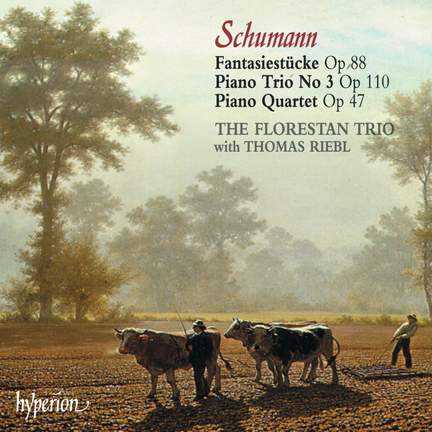
After their 1999 Gramophone Award-winning disc of the first two piano trios, these players champion three works which are less frequently encountered in concert, proving once again how a revelatory...
Schumann: Fantasiestücke Op 88
Thomas Riebl (viola)
The Florestan Trio
Purchase product
After their 1999 Gramophone Award-winning disc of the first two piano trios, these players champion three works which are less frequently encountered in concert, proving once again how a revelatory...
About
Following the huge success of their disc of Schumann's first two Piano Trios (CDA67063) which won a Gramophone Award and was descibed as the best chamber record of 1999 by BBC Radio 3, The Florestan Trio here complete their recording of all Schumann's Trios and present further chamber works by Schumann. In the Piano Quartet the trio are joined by viola player Thomas Riebl who performed the work with them most recently at London's Wigmore Hall, to great critical acclaim. Although the Quartet in E flat has never achieved the same degree of popularity as the famous Quintet that preceeded it, this wonderful performance is sure to win the work new admirers.
Contents and tracklist
Awards and reviews
 2010
2010
After their 1999 Gramophone Award-winning disc of the first two piano trios, these players champion three works which are less frequently encountered in concert, proving once again how a revelatory interpretation can make us all think again.
The G minor Piano Trio (No 3) of 1851 suffers from over-repetitive, at times perfunctory, rhythmic patterning. But thanks to the mercurial vitality and the spontaneous response to every passing innuendo from all three interwoven voices, not a note here sounds unmotivated.
The three fanciful 1842 miniatures for piano trio (revised under the title of Fantasiestücke in 1849) have long been criticised for the dominance of the keyboard in all but the third, entitled 'Duet'. Susan Tomes makes no attempt to disguise this.
Last but not least, the Piano Quartet of 1842, long overshadowed by the much-loved Piano Quintet. Misha Donat's appreciative note reminds us that even the loyal Clara waited some seven years before taking it into her repertory.
The piano is rarely silent, and mustn't be allowed to dominate; so praise goes to Susan Tomes for a keen ear for balance. The Scherzo has a Mendelssohnian, elfin fleetness, and the finale (surely Schumann's ne plus ultra in exhilarating contrapuntal ingenuity) an exemplary textural clarity. The slow movement, played with touching simplicity, speaks as eloquently as any of the composer's Clara-inspired lovesongs.
Excellently recorded, this welcome disc should win all three works a new lease of life.