Bernstein: Symphony No. 2
Marc-André Hamelin (piano)
Ulster Orchestra, Dmitry Sitkovetsky
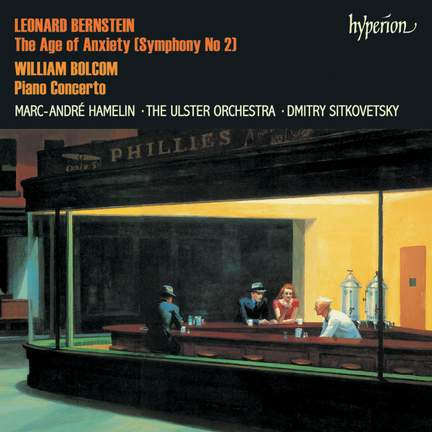
After Hamelin's fantastic virtuosity in the outrageously difficult Godowsky Studies on Chopin'sEtudes (for which he won the Gramophone Instrumental Award 2000) these two works for piano and...
Bernstein: Symphony No. 2
Marc-André Hamelin (piano)
Ulster Orchestra, Dmitry Sitkovetsky
Purchase product
After Hamelin's fantastic virtuosity in the outrageously difficult Godowsky Studies on Chopin'sEtudes (for which he won the Gramophone Instrumental Award 2000) these two works for piano and...
About
These two important American works for piano and orchestra are rather different stylistically but both are concerned with the very 20th-century issues of man's purpose in life and his place in a society when there are no longer any absolute values. As such they are far removed from the conventional idea of the concerto as display piece and both integrate piano and orchestra symphonically (indeed Bernstein calls his work a symphony). Bernstein's The Age of Anxiety is based on a poem of that name by W.H.Auden and its contents follow closely the narrative of that work. It is a moving and predominantly sombre composition though The Masque section is an exhilarating, jazz-inspired piece. Bolcom has, rather like Ives before him, always integrated the disparate styles of popular and serious music in his work and his concerto is no exception. The piece was written in 1976 as a cynical response to the glitz of the American bicentennial celebrations. Though the many quotations from American popular songs in the last movement are meant to be ironic, to most listeners their effect is of a riot of musical humour. Though not much represented in his output for Hyperion, Marc-Andr Hamelin has long made a speciality of American contemporary music. His feel for jazz and the rhythmic drive of much of this music and his interest in popular North American culture make him the ideal interpreter for these major works.
Contents and tracklist
Awards and reviews
 2010
2010
After Hamelin's fantastic virtuosity in the outrageously difficult Godowsky Studies on Chopin'sEtudes (for which he won the Gramophone Instrumental Award 2000) these two works for piano and orchestra are – for him – mere bagatelles.
But this is an impressive release since it contains the most convincing account of Bernstein's Symphony No 2 (1949) in recent years.
The whole piece is Bernstein's obsessive response to Auden's poem The Age of Anxiety, published the year before, about four characters struggling to sort themselves out in New York City. Even though Auden apparently disliked it, you can increasingly hear Bernstein's Symphony as saturated with the poem, its ideas and atmosphere. Often programmatic, it represents a particularly original approach to piano and orchestra and is personal in countless ways – the gentleness of the soft opening and its mystical descending scale, the precisely engineered variations, memorable tunes, a splendid jazzy Scherzo and so on.
Hamelin and the Ulster Orchestra in fine form under Sitkovetsky deliver a well-paced and cogent performance right up to the deliberately inflated, optimistic ending.
Bolcom is one of the most idiosyncratic American composers of the next generation. His 1976 Piano Concerto draws widely on various types of popular music, which he's always performed superbly. The Concerto was written in memory of his teacher, Darius Milhaud, who'd have loved it.
The opening movement is captivatingly serene until the blue notes get out of hand; the slow movement is more stable and serious; but the finale comes over as a riotous celebration of Americana. Unfortunately Bolcom intended it to be ironic, as a kind of anti-bicentennial tribute.
But tunes like these have a habit of occupying centre-stage on their own terms. Hamelin is again utterly scrupulous and idiomatic, and delivers all the musical styles with supreme confidence – nobody could have mixed them up like Bolcom.