Handel: 4 Motets
Annick Massis (soprano), Magdalena Kozená (mezzo-soprano), Magdalena Kozená (soprano), Sara Fulgoni (alto), Patrick Henckens, Kevin McLean-Mair (tenor), Marcos Pujol (bass)
Les Musiciens & Choeur du Louvre (on authentic instruments), Marc Minkowski
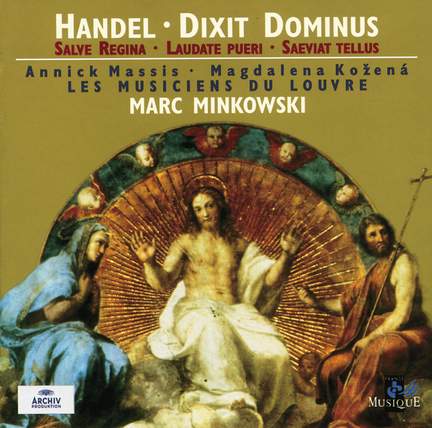
These pieces, written in Handel's early twenties, embody a kind of excitement and freedom, and a richness of ideas, that come from his contact with a different tradition and a sudden realisation...
Handel: 4 Motets
Annick Massis (soprano), Magdalena Kozená (mezzo-soprano), Magdalena Kozená (soprano), Sara Fulgoni (alto), Patrick Henckens, Kevin McLean-Mair (tenor), Marcos Pujol (bass)
Les Musiciens & Choeur du Louvre (on authentic instruments), Marc Minkowski
Purchase product
These pieces, written in Handel's early twenties, embody a kind of excitement and freedom, and a richness of ideas, that come from his contact with a different tradition and a sudden realisation...
About
Contents and tracklist
Handel:
Saeviat tellus inter rigores HWV 240 Motetto per la Madonna Santissima del Carmine
Work length17:29
- Annick Massis (soprano)
- Les Musiciens du Louvre
- Marc Minkowski
- Recorded: 1998-06
- Recording Venue: Radio France, Salle O. Messiaen, Paris
- Magdalena Kožená (mezzo-soprano), Yann Miriel (oboe)
- Les Musiciens du Louvre, Chorus Of Les Musiciens Du Louvre
- Marc Minkowski
- Recorded: 1998-06
- Recording Venue: Radio France, Salle O. Messiaen, Paris
- Magdalena Kožená (mezzo-soprano), Mirella Giardelli (organ)
- Les Musiciens du Louvre
- Marc Minkowski
- Recorded: 1998-06
- Recording Venue: Radio France, Salle O. Messiaen, Paris
- Sara Fulgoni (contralto), Annick Massis (soprano), Magdalena Kožená (soprano), Patrick Henckens (tenor), Kevin McLean-Mair (tenor), Marcos Pujol (bass), Sébastian Rouland (chorusmaster), Michel Gache (videoscripteditor), Philippe Malidin (videoscripteditor)
- Les Musiciens du Louvre, Chorus Of Les Musiciens Du Louvre
- Marc Minkowski
- Recorded: 1998-06
- Recording Venue: Radio France, Salle O. Messiaen, Paris
Awards and reviews
 2010
2010
These pieces, written in Handel's early twenties, embody a kind of excitement and freedom, and a richness of ideas, that come from his contact with a different tradition and a sudden realisation that the musical world was larger and less constricted than he had imagined, tucked away in provincial middle and north Germany. You can hear him stretching his musical wings in this music. And it certainly doesn't fail to take off in these very lively performances. The quickish tempos habitually favoured by Marc Minkowski are by no means out of place here. The Saeviattellus, although little recorded, is pretty familiar music, as Handel recycled most of it, notably the brilliant opening number in Apollo e Dafne and the lovely 'O nox dulcis' in Agrippina. This is a solo motet, as too is the Salve regina, notable for the expressive vocal leaps and chromatic writing in the 'Ad te clamamus' and the solo organ and string writing in the 'Eia ergo' that follows.
Laudate pueri, which uses a choir, is another fresh and energetic piece: the choir of the Musiciens du Louvre do their pieces in rousing fashion, and there's some happy oboe playing, as well as fine singing from KoOená, earlier on, in particular in the hugely spirited 'Excelsus super omnes'. The biggest item is the Dixit Dominus, where the choir sings very crisply. The illustrative settings of 'ruinas' tumbling down through the registers, and the 'conquassabit' that follows, are truly exciting; and the long closing chorus is done with due weight at quite a measured pace.
These splendid performances truly capture the spirit of these marvellous pieces.