Special offer. Brahms: Ein Deutsches Requiem, Op. 45
Sandrine Piau (soprano), Stéphane Degout (baritone), Brigitte Engerer (piano), Boris Berezovsky (piano)
accentus Chamber Choir, Laurence Equilbey
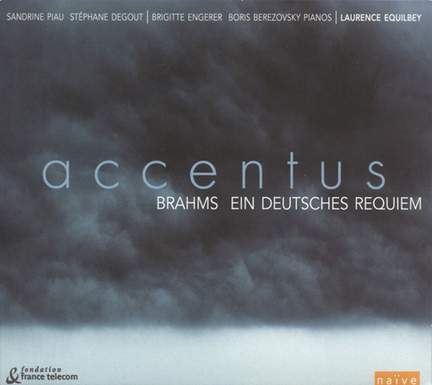
For the opposite of heavyweight, sample this lithe Requiem from choir Accentus, with Brahms's own re-worked piano duet to accompany.
Special offer. Brahms: Ein Deutsches Requiem, Op. 45
Sandrine Piau (soprano), Stéphane Degout (baritone), Brigitte Engerer (piano), Boris Berezovsky (piano)
accentus Chamber Choir, Laurence Equilbey
Purchase product
For the opposite of heavyweight, sample this lithe Requiem from choir Accentus, with Brahms's own re-worked piano duet to accompany.
About
Contents and tracklist
- Sandrine Piau (soprano), Stéphane Degout (baritone), Brigitte Engerer (piano), Boris Berezovsky (piano)
- Accentus Chamber Choir
- Laurence Equilbey
Awards and reviews
 February 2011
For the opposite of heavyweight, sample this lithe Requiem from choir Accentus, with Brahms's own re-worked piano duet to accompany.
 2010
2010
It was in Wimpole Street in 1871, at the home of a leading surgeon and his musical wife, that the London first performance of Brahms's Deutsches Requiem was given, two years before it was introduced to the British public at large and with orchestral scoring. The arrangement for piano duet was the composer's own, made at the urgent request of his publisher. The occasion was essentially a domestic one, with a small invited audience, piano duettists and singers who, having sung of all flesh being grass, would doubtless have found cold meats laid out for them in the dining room and a glass of wine to refresh the spirits.
This recording successfully presents the Requiem as chamber music. An earlier performance on Opus 111 suggested a final piano rehearsal, the orchestra being expected next week. Here the piano part is played on two instruments, achieving a far more satisfying musical finish. The playing is sensitive, with a singing tone most of the time, and a keen ear for the differentiation between parts or melodic strands. Sandrine Piau is clear-toned and well in control after a very slightly tremulous start; Stéphane Degout, a fine baritone, isn't particularly expressive here but admirable in quality and phrasing. The choir sing with fresh, well-matched tones and care for detail. Choice of tempo seems unerringly right: that is but one of many reasons we have to be grateful to Laurence Equilbey, the conductor.