Special offer. Beethoven: Fidelio, Op. 72
Charlotte Margiono (Leonore), Peter Seiffert (Florestan), László Polgár (Rocco), Sergei Leiferkus (Pizarro), Barbara Bonney (Marzelline), Deon van der Walt (Jaquino), Bo Skovus (Fernando), Reinaldo Macias (First Prisoner), Robert Florianschutz (Second Prisoner)
Schoenberg Choir, Chamber Orchestra...
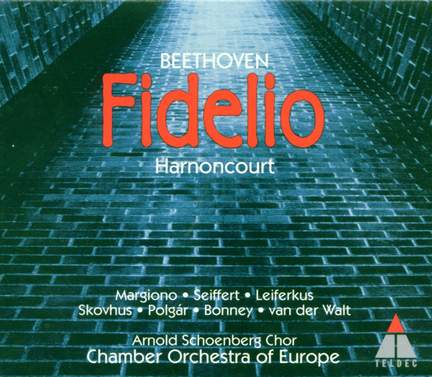
Everything Harnoncourt touches leaves a sense of a country rediscovered: we listen to the piece in hand with new ears. So it is again here. Beethoven's sole but intractable opera has seldom...
Special offer. Beethoven: Fidelio, Op. 72
Charlotte Margiono (Leonore), Peter Seiffert (Florestan), László Polgár (Rocco), Sergei Leiferkus (Pizarro), Barbara Bonney (Marzelline), Deon van der Walt (Jaquino), Bo Skovus (Fernando), Reinaldo Macias (First Prisoner), Robert Florianschutz (Second Prisoner)
Schoenberg Choir, Chamber Orchestra...
Purchase product
Everything Harnoncourt touches leaves a sense of a country rediscovered: we listen to the piece in hand with new ears. So it is again here. Beethoven's sole but intractable opera has seldom...
About
Contents and tracklist
Act 1 "Leb wohl, du warmes Sonnenlicht" [Chorus, Marzelline, Leonore, Jaquino, Pizarro, Rocco]
Track length3:47
Act 2 "Des besten Königs Wink und Wille" [Fernando, Chorus, Rocco, Pizarro, Leonore, Marzelling, Florestan]
Track length8:34
Awards and reviews
 2010
2010
Everything Harnoncourt touches leaves a sense of a country rediscovered: we listen to the piece in hand with new ears. So it is again here. Beethoven's sole but intractable opera has seldom emerged from the recording studio, or indeed the theatre, with such clarity of texture, such promptness of rhythm, such unity of purpose on all sides. This is a reading that gives full play to winds and horns, making you aware, whether it's in the Overture, Pizarro's aria, Leonore's big scena or the Prelude to Act-2, just how important they are to the structure and character of each movement. Where tempos are concerned, Harnoncourt is almost bound to be controversial somewhere. If many speeds are to their advantage just on the measured side of the customary, as in the Dungeon quartet, allowing us for once to hear every strand of the argument, that for 'O namenlose Freude' is uncommonly moderate. At this pace, Leonore and Florestan seem to be conducting a gentle exchange of deeply felt emotions on an interior level rather than allowing their pent-up emotions to burst forth in an explosion of joy, as is more usual.
The dialogue is delivered in an understated fashion. Two vocal interpretations stand out for excellent singing and pungent characterisation.
Once Leiferkus's Pizarro takes centre-stage the action lifts on to a new, more tense plane. This vicious little dictator with his incisive diction, spoken and sung, and his biting, vital voice is a commanding presence. But Evil is up against an equally arresting advocate of Good in Margiono's gloriously sung and read Leonore. Hers isn't the quasi-dramatic soprano usually associated with the part, but she never sounds strained in the context of a more lyrical, smaller-scale performance. Seiffert fills Florestan with more refulgent tone than any other tenor on recent recordings – the high tessitura of his aria's close causes him no distress at all – but it must be admitted that there's little of the Schmerz in the tone found, quite differently, in the recording of Vickers (Klemperer). In that sense, though, he fits into Harnoncourt's well-ordered scheme of things. The only piece of miscasting is Don Fernando: a role that needs a solid bass with strong low notes has been given to a high baritone who sounds anything but authoritative.
Harnoncourt has opted for a professional chamber choir to second the superb Chamber Orchestra of Europe. By the side of the superb Teldec recording, the Klemperer and Maazel sound less than immediate.