Thomas Tallis - Complete Works Volume 3
Music for Queen Mary
Chapelle du Roi, Alistair Dixon
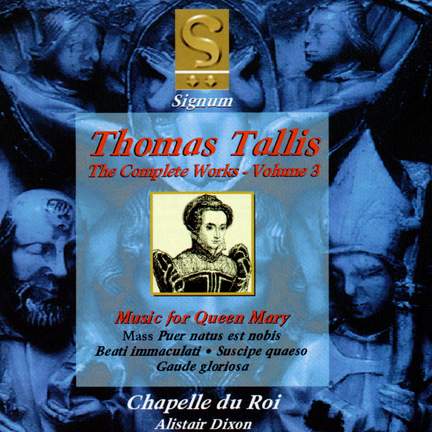
The illuminating insert-notes place Mary's short reign within the bewilderingly stormy context of the 16th century with a calm understanding that enables the listener to see how this Latin music...
Thomas Tallis - Complete Works Volume 3
Music for Queen Mary
Chapelle du Roi, Alistair Dixon
Purchase product
The illuminating insert-notes place Mary's short reign within the bewilderingly stormy context of the 16th century with a calm understanding that enables the listener to see how this Latin music...
About
Contents and tracklist
Gaude gloriosa
Work length17:11
This work is only available as an album download.
Awards and reviews
 2010
2010
The illuminating insert-notes place Mary's short reign within the bewilderingly stormy context of the 16th century with a calm understanding that enables the listener to see how this Latin music came to be written. Incidentally, the first piece was originally an English setting of Beatus vir. Sandon says it falls naturally into place with its Latin text. But the verses in the booklet don't exactly correspond to what's being sung, which raises an unnecessary question mark. Sandon's edition of the Proper Salisbury chants for the Third Mass of Christmas are performed between the polyphonic items. Meticulously researched, they serve as a foil to the sumptuous settings of the Ordinary.
If only they had been sung with more solemnity and gusto, omitting those irritating little bursts of volume on the high notes! All these chants would have sounded more authentic at a slower tempo with the occasional semi-metrical dactyl: as it is, they comes across rather as a poor relation beside the magnificence of Tallis's seven-part polyphony.
The polyphonic singing is exemplary, the clarity of the individual parts and the rhythmic interplay well under control. The singers enter into the spirit of the liturgical texts, in particular in the third section of the Agnus Dei. Their interpretation of the final motet, Gaude gloriosa, at times almost touches the visionary.