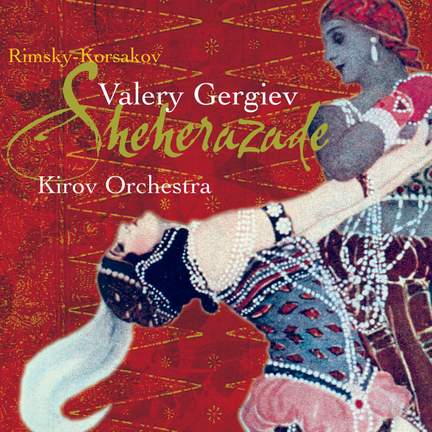
Special offer. Rimsky Korsakov: Scheherazade
Sergei Levitin (violin)
Kirov Orchestra, Valery Gergiev
Awards:
-
Gramophone Magazine, November 2002, Editor's Choice

[Gergiev] bring[s] out Rimsky's crystalline solo textures, such as the passages for solo cello, horn and woodwinds in the first movement. And if tempos are slow in the first three movements,...
Special offer. Rimsky Korsakov: Scheherazade
Sergei Levitin (violin)
Kirov Orchestra, Valery Gergiev
Purchase product
Awards:
-
Gramophone Magazine, November 2002, Editor's Choice
[Gergiev] bring[s] out Rimsky's crystalline solo textures, such as the passages for solo cello, horn and woodwinds in the first movement. And if tempos are slow in the first three movements,...
About
Contents and tracklist
- Sergei Levitin (violin)
- Mariinsky (Kirov) Orchestra
- Valéry Gergiev
- Recorded: 2001-11
- Recording Venue: Mariinsky Theatre, St. Petersburg
- Mariinsky (Kirov) Orchestra
- Valéry Gergiev
- Recorded: 2001-11
- Recording Venue: Mariinsky Theatre, St. Petersburg
- Mariinsky (Kirov) Orchestra
- Valéry Gergiev
- Recorded: 2001-11
- Recording Venue: Mariinsky Theatre, St. Petersburg
Awards and reviews
-
Gramophone MagazineNovember 2002Editor's Choice
 25th February 2003
[Gergiev] bring[s] out Rimsky's crystalline solo textures, such as the passages for solo cello, horn and woodwinds in the first movement. And if tempos are slow in the first three movements, Gergiev makes up for lost time in the fiery, bristling fourth, which becomes a tour-de-force for an orchestra clearly at the height of its powers
 2010
2010
Recorded under live conditions but without an audience in St Petersburg's Mariinsky Theatre, this Scheherazade is the most red-blooded, exciting account of Rimsky-Korsakov's orchestral warhorse currently available, helped by full, immediate sound of a richness rare in Russian recordings. The magnetism is established from the start, with Gergiev completely dispelling the feeling that this is a work which keeps stopping and starting too often for its own good. Consistently you register that these are players who have the music in their blood, with rubato naturally inflected. In expressive freedom Gergiev is often less extreme than Reiner or Karajan, as in the quasi recitando bassoon solo near the start of the second movement or the espressivo oboe solo which follows, in which Gergiev notes also the atempo marking, keeping it steady. The virtuosity of the St Petersburg soloists conveys an edge-ofseat tension, particularly when Gergiev opts for challengingly fast speeds in the climactic passages of the second and fourth movements.
This is a work written over only a few weeks, and far more than usual this is a performance that, defying the many changes of tempo, conveys that urgency of inspiration. Yet Gergiev brings out points of detail in the brilliant instrumentation normally bypassed, as in the upward glissando for the cellos in the opening section of the third movement, either ignored or merely hinted at by others.
Two points might be counted controversial.
The tempo for that opening section of the third movement, 'The Young Prince and Princess', is markedly slower than with the others. Yet in context Gergiev conjures extra contrast with the other movements. The other point is that, though the recorded sound has spectacular weight and power over the widest range, it's clear that reverberation has been added to a recording made in a relatively dry theatre acoustic. Happily, it doesn't get in the way of orchestral detail. Both performance and recording, whatever the acoustic juggling, have a power that pins you back in your seat.