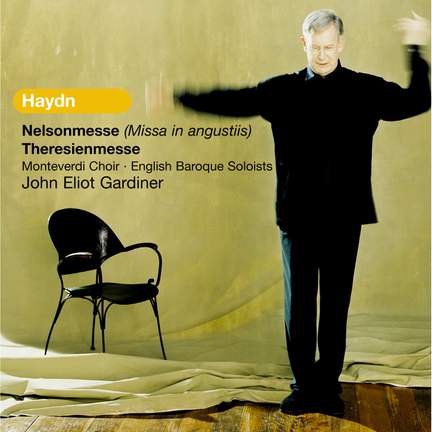
Special offer. Haydn Masses Vol. 2
Donna Brown (soprano), Sally Bruce-Payne (mezzo-soprano), Peter Butterfield (tenor), Gerald Finley (bass)
English Baroque Soloists, Monteverdi Choir, John Eliot Gardiner
Awards:
-
Gramophone Magazine, January 2003, Disc of the Month

Another fine performance. True to form, Gardiner exults more fiercely than anyone in Gloria, with hungry rhythms and extreme dynamic contracts, and brings a unique hushed tension to the 'Crucifixus'.
Special offer. Haydn Masses Vol. 2
Donna Brown (soprano), Sally Bruce-Payne (mezzo-soprano), Peter Butterfield (tenor), Gerald Finley (bass)
English Baroque Soloists, Monteverdi Choir, John Eliot Gardiner
Purchase product
Awards:
-
Gramophone Magazine, January 2003, Disc of the Month
Another fine performance. True to form, Gardiner exults more fiercely than anyone in Gloria, with hungry rhythms and extreme dynamic contracts, and brings a unique hushed tension to the 'Crucifixus'.
About
Contents and tracklist
- Donna Brown (soprano), Sally Bruce-Payne (mezzo-soprano), Peter Butterfield (tenor), Gerald Finley (bass)
- Monteverdi Choir, English Baroque Soloists
- Sir John Eliot Gardiner
- Recorded: 1997-11
- Recording Venue: The Colosseum, Watford
- Monteverdi Choir, English Baroque Soloists
- Sir John Eliot Gardiner
- Recorded: 2001-11
- Recording Venue: The Colosseum, Watford
- Donna Brown (soprano), Sally Bruce-Payne (mezzo-soprano), Peter Butterfield (tenor), Gerald Finley (bass)
- Monteverdi Choir, English Baroque Soloists
- Sir John Eliot Gardiner
- Recorded: 1997-11
- Recording Venue: The Colosseum, Watford
Awards and reviews
-
Gramophone MagazineJanuary 2003Disc of the Month
 February 2008
Another fine performance. True to form, Gardiner exults more fiercely than anyone in Gloria, with hungry rhythms and extreme dynamic contracts, and brings a unique hushed tension to the 'Crucifixus'.
 2010
2010
Dating respectively from 1798 and 1799, the Nelsonmesse and the Theresienmesse are the third and fourth of the six masses written for the nameday of the Princess Esterházy. That was a period during the Napoleonic wars when Prince Esterházy, Nikolaus II had economised by dismissing his Harmonie or windband. Even so, in 1798 for the Nelsonmesse, Haydn, seeking to reflect the mood of the times (hence the official title, Missa in angustiis – 'Mass in straitened times'), brought in three trumpets and timpani, and their impact is all the greater when set against strings and organ alone.
That heightened contrast is a point which comes out with thrilling attack in Gardiner's performance at the very opening of the Kyrie.
This vigorous Allegro, typical of Haydn but totally untypical of Mass-settings, introduces martial fanfares, which recur through the whole work. Though Haydn composed the Mass in a mere 53 days in the summer of 1798, just when Nelson was winning the Battle of Aboukir, Haydn knew nothing of that victory till later, and the Nelson association dates from two years later when the admiral visited Eisenstadt, and the Mass was given in his honour.
Gardiner's treatment of the fanfares offers only the first of dozens of examples where his crisp, incisive manner highlights the extraordi- nary originality of this work. The Theresienmesse brings similar revelations. Here, in addition to trumpets and timpani, Haydn scored for two clarinets, and though this is a less sharply dramatic, more lyrical work, a martial flavour is again introduced. There are surprises aplenty, as in the sudden silence of the orchestra in the setting of the word 'miserere' at the end of the 'Gratias agimus tibi', or the setting of 'Et incarnatus' in the Credo in the rare key (in this context) of B flat minor, and 'Et vitam venturi' set in a galloping 6/8 time or the bold, square opening of Agnus Dei in bare octaves at an unapologetic forte. Such points must have startled early listeners, and Gardiner's treatment makes one appreciate that with new ears.
In this respect he even outshines Richard Hickox, whose prize-winning Mass series for Chandos brings equally enjoyable performances of both these works, just as energetic and a degree warmer, thanks in part to the recording acoustic. Gardiner's team, on the other hand, has markedly cleaner separation of textures, with soloists and chorus more sharply defined.
Gardiner's Monteverdi Choir as ever sings with passion, brilliance and fine precision, and his soloists are all outstanding, fresh and youthfulsounding with firm clear voices.
As a splendid, very apt bonus there's a superb account of the magnificent ceremonial C major Te Deum.