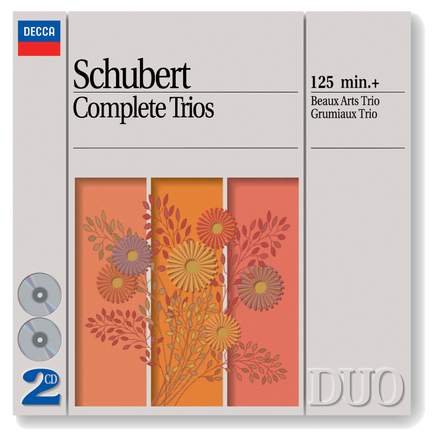
Schubert - Complete Trios
Grumiaux Trio, Beaux Arts Trio
Awards:
-
Building a Library, May 2011, First Choice

These performances are polished, yet the many solo contributions from each of the players emerge with a strong personality. The Beaux Arts cellist brings lovely phrasing and a true simplicity...
Schubert - Complete Trios
Grumiaux Trio, Beaux Arts Trio
Purchase product
Awards:
-
Building a Library, May 2011, First Choice
These performances are polished, yet the many solo contributions from each of the players emerge with a strong personality. The Beaux Arts cellist brings lovely phrasing and a true simplicity...
About
Contents and tracklist
- Arthur Grumiaux (violin), Georges Janzer (viola), Eva Czako (cello)
- Grumiaux Trio
- Recorded: 1969-02
- Recording Venue: La Chaux-De-Fonds
- Arthur Grumiaux (violin), Georges Janzer (viola), Eva Czako (cello)
- Grumiaux Trio
- Recorded: 1969-02
- Recording Venue: La Chaux-De-Fonds
- Menahem Pressler (piano), Daniel Guilet (violin), Bernard Greenhouse (cello)
- Beaux Arts Trio
- Recorded: 1966
- Beaux Arts Trio (pianotrio), Menahem Pressler (piano), Daniel Guilet (violin), Bernard Greenhouse (cello)
- Recorded: 1966
- Beaux Arts Trio (pianotrio), Menahem Pressler (piano), Daniel Guilet (violin), Bernard Greenhouse (cello)
- Recorded: 1966
- Menahem Pressler (piano), Daniel Guilet (violin), Bernard Greenhouse (cello)
- Beaux Arts Trio
- Recorded: 1966
Awards and reviews
 2010
2010
These performances are polished, yet the many solo contributions from each of the players emerge with a strong personality. The Beaux Arts cellist brings lovely phrasing and a true simplicity of line, so right for Schubert-–-memorably in the lovely slow movement melody of the Trio No 2 in E flat. In addition to the great piano trios (B flat, D898 and E flat, D929) the set includes the extremely personable, very early Sonata in B flat, D28, where the lyrical line already has the unmistakable character of its young composer.
Also included is the Notturno, D897, a raptly emotive short piece played here with a remarkable depth of feeling that recalls the gentle intensity of the glorious slow movement of the String Quintet. The recording is naturally balanced, although a little dry in the treble. Of the two rarer string trios, also early works, the four-movement Trio, D581, is totally infectious, with that quality of innocence that makes Schubert's music stand apart. Such persuasive advocacy and vivid recording can't fail to give the listener great pleasure.