Gossec: Missa Pro Defunctis
Salomé Haller, Ingrid Perruche, Cyril Anvity, Benoît Haller, Alain Buet, Katalin Varkonyi
Choeur de Chambre de Namur, La Grande Ecurie et la Chambre du Roy, Jean-Claude Malgoire
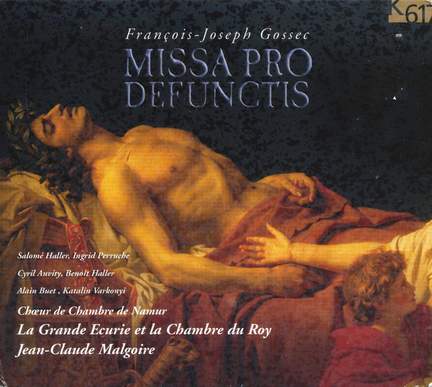
Gossec is a name more often found in history books than on record collectors' shelves. During his long life he contributed to opera reform in Paris before the arrival of Gluck, was one of the...
Gossec: Missa Pro Defunctis
Salomé Haller, Ingrid Perruche, Cyril Anvity, Benoît Haller, Alain Buet, Katalin Varkonyi
Choeur de Chambre de Namur, La Grande Ecurie et la Chambre du Roy, Jean-Claude Malgoire
Purchase product
Gossec is a name more often found in history books than on record collectors' shelves. During his long life he contributed to opera reform in Paris before the arrival of Gluck, was one of the...
About
Contents and tracklist
- Salome Haller, Ingrid Perruche, Cyril Auvity, Alain Buet, Katalin Várkonyi, Benoît Haller
- La Grande Ecurie et la Chambre du Roy, Chœur de Chambre de Namur
- Jean-Claude Malgoire
Awards and reviews
 2010
2010
Gossec is a name more often found in history books than on record collectors' shelves. During his long life he contributed to opera reform in Paris before the arrival of Gluck, was one of the directors of the Concert Spirituel, and wrote 50 symphonies. In old age he became the foremost composer of French revolutionary themes, and the first anniversary of the fall of the Bastille was commemorated with a performance of his TeDeum that featured over a thousand performers.
The Missa pro defunctis had more modest origins.
It was first performed in 1760, and aroused notable reaction due to the use of trombones, a novelty.
The Dies Irae – featuring horns, clarinets and drums – became a popular concert item. The composer revised and revived it several times over the next two decades, and parts of the Mass were used for large-scale patriotic commemorations during the revolutionary period.
This recording, made in the chapel at Versailles in 2002, efficiently captures a special event. Occasionally the most intricate details in the accompaniment of soloists seem slapdash, but the rich and imposing grandeur of Le Grande Ecurie et La Chambre du Roy's woodwind and brass remind us that Gossec's fiery dramatic work was a clear influence on Berlioz's colossal choral works. The music sounds astonishingly Mozartian, despite its earlier origin.
Jean-Claude Malgoire's strongest asset has always been to give performances with immediacy and character, albeit sometimes sacrificing technical perfection. But when his forces are on form, as they are here, the results are emotionally natural, musically dramatic and neatly direct.