Special offer. The Hyperion Schubert Edition - Complete Songs Volume 37
The Final Year
John Mark Ainsley, Anthony Rolfe Johnson, Michael Schade (tenors), Graham Johnson (piano)
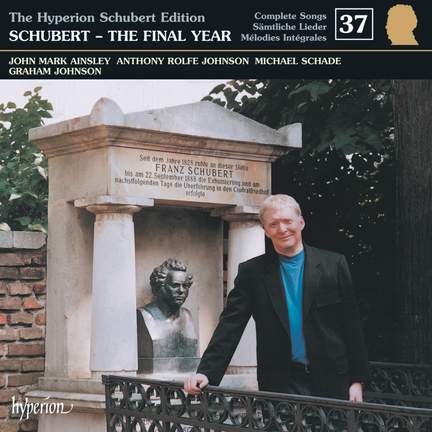
This disc, the last in Hyperion's Schubert Edition, is in large part devoted to the performance of the non-cycle Schwanengesang, that extraordinary collection in which Schubert seems more original...
Special offer. The Hyperion Schubert Edition - Complete Songs Volume 37
The Final Year
John Mark Ainsley, Anthony Rolfe Johnson, Michael Schade (tenors), Graham Johnson (piano)
Purchase product
This disc, the last in Hyperion's Schubert Edition, is in large part devoted to the performance of the non-cycle Schwanengesang, that extraordinary collection in which Schubert seems more original...
About
The glories of this final disc in the Hyperion Schubert Edition are hard to over-praise. Three tenors sing 20 songs from 1828, the last year of Schuberts short life. The programme begins with Auf den Strom (On the River) sung by German/Canadian Michael Schade, with horn obbligato superbly played by David Pyatt. This is followed by Herbst, the two unrecorded Refrainlieder and a fragment, Lebensmut. Then follows Schwanengesang sung by two tenors: John Mark Ainsley sings the Rellstab settings (including a wondrous Stndchen and a heartrending In der Ferne) and Anthony Rolfe Johnson sings the Heine ones (including a hair-raising Dppelgnger) and, at the end, Die Taubenpost, Schuberts last song. The two halves of Schwanengesang are separated by Glaube, Hoffnung und Liebe sung by all three tenors. All of the music on this album is also available as part of the specially priced box set The Complete Songs of Franz Schubert: This is an archive of glorious Lieder singing as much as it is a definitive treasury of the greatest Lieder ever composed (The Guardian).
Contents and tracklist
Awards and reviews
 2010
2010
This disc, the last in Hyperion's Schubert Edition, is in large part devoted to the performance of the non-cycle Schwanengesang, that extraordinary collection in which Schubert seems more original and more inclined even than in earlier Lieder to peer into the future. We usually encounter the work transposed for a baritone, though Schreier and Schiff have recorded it memorably for Decca. Johnson has astutely divided the songs between two voices. Ainsley is given the Rellstab settings, Rolfe Johnson the Heine, plus Seidl's Die Taubenpost, which so poignantly and airily closes the set.
Ainsley interprets his songs with the tonal beauty, fine-grained phrasing and care for words that are the hallmarks of his appreciable art, even if his voice sometimes lacks a difficult-to-define individuality of timbre. The over-exposed Ständchen is given a new spontaneity of utterance by both the singer and Graham Johnson. Anthony Rolfe Johnson brings all the appropriate intensity one would expect from him to the tremendous Heine settings. Sometimes his tone hardens when he's depicting the deserted lover present in so many of these pieces, but that's hardly inappropriate to the depth of feeling being expressed.
Most of the other songs of 1828, which open the recital, are assigned to Schade, who sings them with refined tone and an innate feeling for sharing his enjoyment in performing them, nowhere more so than in the opening Auf demStrom. Ainsley reads his sole offering here, Beidir allein, with just the fiery passion it calls for.
This is a worthy, often inspired conclusion to the series, once more enhanced by Johnson's copious notes. It also has a complete index to the Edition. The recording is faultless.