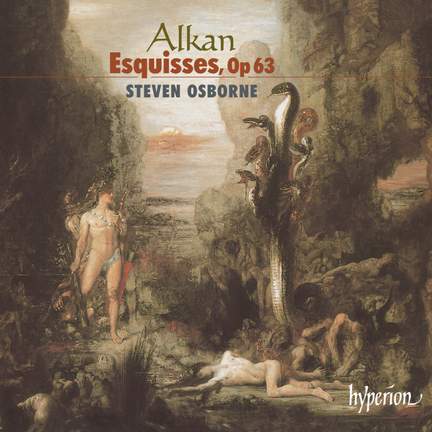
Alkan: Esquisses (48), Op. 63
Steven Osborne (piano)
Awards:
-
Gramophone Magazine, September 2003, Editor's Choice

Here's a superlative record of music to confound the sceptics, including the soloist himself, who, in a witty, concentrated essay, expresses his surprise at discovering Alkan's Esquisses and...
Alkan: Esquisses (48), Op. 63
Steven Osborne (piano)
Purchase product
Awards:
-
Gramophone Magazine, September 2003, Editor's Choice
Here's a superlative record of music to confound the sceptics, including the soloist himself, who, in a witty, concentrated essay, expresses his surprise at discovering Alkan's Esquisses and...
About
The renaissance of interest in the reclusive and eccentric 19th-century French composer Alkan has been one of the more interesting developments of the last part of the 20th century but it has usually been his massive and virtuoso works (the symphony and concerto for solo piano for example) which have made the biggest impression. Throughout his life though Alkan was also a miniaturist, as 25 Preludes and six books of Chants show, and this interest culminated in undoubtedly the greatest of these cycles, the Esquisses (sketches) here recorded. This set of 48 pieces plus a final Laus Deo runs through all 24 keys twice with the Laus Deo returning the double cycle to C major. A huge range of mood and colour is represented from simple folk song to etude, not forgetting the bizarre, as can be seen in the tone clusters of Les Diablotins or the schizophrenic Hraclite et Dmocrite. This cycle has only been recorded complete once before. With Steven Osborne applying his colour, virtuosity and interpretive insight we are confident we have produced a recording that will permanently raise the stature of these pieces in the musical world and add a significant milestone in the Alkan discography.
Contents and tracklist
Awards and reviews
-
Gramophone MagazineSeptember 2003Editor's Choice
 2010
2010
Here's a superlative record of music to confound the sceptics, including the soloist himself, who, in a witty, concentrated essay, expresses his surprise at discovering Alkan's Esquisses and their journey into intimacy rather than gargantuan bravura. Not that these 48 fragments, many of them of a teasing and enigmatic brevity, could be by any other composer. Gnomic, introspective, full of odd twists and turns of phrase and expression, they invariably catch you unawares.
In 'Confidence', a Field-like innocence is countered by enough surprises to declare the composer's identity. 'Les soupirs' is so much more than a foretaste of Debussyan impressionism.
'Inflexibilité' holds the listener in a vicelike grip and the change from charm ('Petite marche villageoise') to grimness ('Morituri te salutant') is typical of Alkan's volatile yet rigorous command of the widest variety of ideas and pastiches. 'Le frisson', 'Pseudo-naïveté', 'Délire', 'Fais Dodo', 'L'homme aux sabots' – the titles predict an eccentricity that's nonetheless qualified by a formidable intellectual focus.
Osborne's performances are of a sensitivity, radiance and finesse rarely encountered from even the finest pianists. He floats the opening of 'La vision' in a magical haze or nimbus of sound, peppers the keyboard with an immaculate virtuosity in 'La staccatissimo', relishes the Norwegien tang of 'Début de quatuor' and brings a wicked frisson to 'Les diablotins', where Alkan's little devils are hustled from the field almost as if the composer had lost patience with his own grotesque creation.
Misha Donat's notes are as affectionate as they are perceptive, and Hyperion's sound is of demonstration quality. An invaluable disc, particularly for those drawn to music's byways.