Corelli: Violin Sonatas, Op. 5
Andrew Manze (violin), Richard Egarr (harpsichord)
Awards:
-
Gramophone Magazine, April 2003, Disc of the Month

-
Penguin Guide, Rosette

-
Building a Library, May 2018, Also recommended

Corelli's Sonatas have never felt more alive and less perfectly preserved than they do here, and if you care at all for the baroque repertoire or fine fiddle playing, you owe it to yourself...
Corelli: Violin Sonatas, Op. 5
Andrew Manze (violin), Richard Egarr (harpsichord)
Purchase product
Awards:
-
Gramophone Magazine, April 2003, Disc of the Month
-
Penguin Guide, Rosette
-
Building a Library, May 2018, Also recommended
Corelli's Sonatas have never felt more alive and less perfectly preserved than they do here, and if you care at all for the baroque repertoire or fine fiddle playing, you owe it to yourself...
About
A dazzling version of arguably the finest set of violin sonatas ever assembled, with the fresh approach to the text and newly improvised ornaments which have become Andrew Manze’s and Richard Egarr’s hallmark.
A dazzling version of arguably the finest set of violin sonatas ever assembled, with the fresh approach to the text and newly improvised ornaments which have become Andrew Manze’s and Richard Egarr’s hallmark.Contents and tracklist
Corelli:
Sonata, Op. 5 No. 12 in D Minor "Follia": Adagio - Allegro - Adagio - Vivace - Allegro - Andante - Allegro - Adagio - Allegro
Work length12:11
Awards and reviews
-
Gramophone MagazineApril 2003Disc of the Month
-
Penguin GuideRosette
 17th March 2003
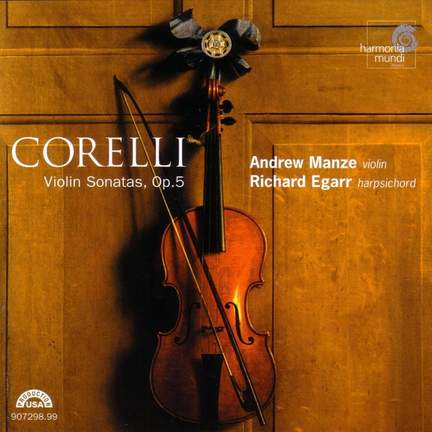
Corelli's Sonatas have never felt more alive and less perfectly preserved than they do here, and if you care at all for the baroque repertoire or fine fiddle playing, you owe it to yourself to hear these exhilarating performances. Everything's come together for this one: repertoire, performers, recording, notes, even the perfect artwork for the cover.
 2010
2010
Considering the acknowledged status of Corelli's Op 5 violin sonatas, it's surprising how few of today's star Baroque violinists have recorded them. Published as a clear statement of intent on January 1, 1700, they're a benchmark not only in the history of the violin but of chamber music in general; yet despite being an accepted model of compositional purity and refinement which lasted throughout the 18th century and beyond, for many music-lovers – even Baroque musiclovers – they're still relatively little-known territory.
Perhaps it's their finely honed perfection which has counted against them. Maybe they just seem too polite. Accounts of Corelli's violin- playing tell us that his eyes would glow 'red as fire' and his face contort, but evidence of this volatile character has not not always been easy to detect in the written notes of the violin sonatas.
If anyone is going to find him, however, it's Andrew Manze, who has repeatedly demonstrated that the heart of Baroque music lies beyond what's on the printed page. At a time when improvisational flair and spontaneity have never been a more exciting part of Baroque music-making, Manze and his accompanist Richard Egarr are the masters of it, and here they have produced a Corelli recording which is nothing short of revelatory.
Not that it's unthinkingly wild or bizarre.
Manze may have adorned the music with his customarily liberal decoration of extra doublestops, flowery arabesques and emphatic gestures – and Egarr may have performed his usual extraordinary feats at the keyboard, devising an array of inventive keyboard textures which ranges from luxurious feather-bed arpeggios and swirls to daring, stabbing left-hand double octaves (no other continuo player manages to sound so much as if his fingers were a direct extension of his imagination) – but this is still Corelli with a measure of north Italian dignity.
The resulting balance between restraint and urgency is compelling, because the performers, you feel, aren't out to shock but to search for something new and real. This really is Corelli as you haven't heard him before. The performances reach a high technical standard, as does the recording, though strangely long gaps are left between some of the movements. This vital, earopening disc is in a category of its own, classic music in a classic recording.

This is baroque violin-playing without peer today