Donizetti: Poliuto
Maria Callas, Franco Corelli, Ettore bastianini, Nicola Zaccaria
La Scala Milan Chorus & Orchestra, Antonino Votto
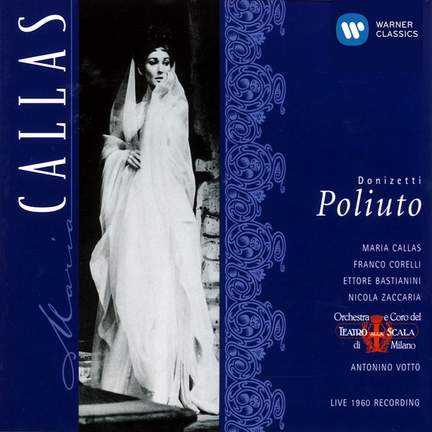
This is the first appearance of this recording in the official canon, by incorporation into EMI's Callas Edition; and the quality is certainly an improvement on the previous 'unofficial' incarnation....
Donizetti: Poliuto
Maria Callas, Franco Corelli, Ettore bastianini, Nicola Zaccaria
La Scala Milan Chorus & Orchestra, Antonino Votto
Purchase product
This is the first appearance of this recording in the official canon, by incorporation into EMI's Callas Edition; and the quality is certainly an improvement on the previous 'unofficial' incarnation....
About
Contents and tracklist
- Salvatore Cammarano (audio generator engineer), Franco Corelli (vocals), Piero de Palma (vocals), Maria Callas (soprano), Virgilio Carbonari (bass), Giuseppe Morresi (bass), Ettore Bastianini (bass-baritone), Nicola Zaccaria (bass), Rinaldo Pelizzoni (vocals)
- Teatro alla Scala, Noberto Mola
- Antonino Votto
- Recorded: 1960-12-07
- Recording Venue: 7 December 1960 / 'live' in the Teatro alla Scala, Milano
Poliuto (1997 Digital Remaster), ATTO PRIMO, Scena prima: Di quai soavi lagrime (Paolina)
Track length3:06
Lasciami in pace morire (Severo / Paolina / Poliuto / Nearco / Felice / Callistene / Coro)
Track length3:20
Awards and reviews
 2010
2010
This is the first appearance of this recording in the official canon, by incorporation into EMI's Callas Edition; and the quality is certainly an improvement on the previous 'unofficial' incarnation.
The sound is clear and faithful to the timbre of the voices, which are slightly favoured in the balance at the expense of the orchestra.
With it comes unforgettable testimony to what was clearly a great night at La Scala. Its place in the Callas history owes less to the importance of this new role in her repertory than to the triumph of her return to the house she had left in high dudgeon in 1958. The part of Paolina in this Roman tragedy is restricted in opportunities and leaves the centre of the stage to the tenor. In other ways it suits her remarkably well, the Second Act in particular involving the heroine in grievous emotional stress with music that here runs deep enough to give it validity.
There's a big part for the chorus, which sings with fine Italian sonority. Nicola Zaccaria, La Scala's leading basso cantabile, has not quite the sumptuous quality of his predecessors, Pasero and Pinza, but is still in their tradition. Ettore Bastianini is rapturously received and, though wanting in polish and variety of expression, uses his firm and resonant voice to exciting effect.
The tenor comprimario, Piero de Palma cuts a by no means inadequate vocal figure by the side of Corelli, who's mostly stupendous: it isn't just the ring and range of voice that impress, but a genuinely responsive art, his aria 'Lasciando la terra' in Act 3 providing a fine example. It's for his part in the opera, quite as much as for Callas's, that the recording will be valued.