Adams, J: Harmonielehre, etc.
City of Birmingham Symphony Orchestra, Simon Rattle
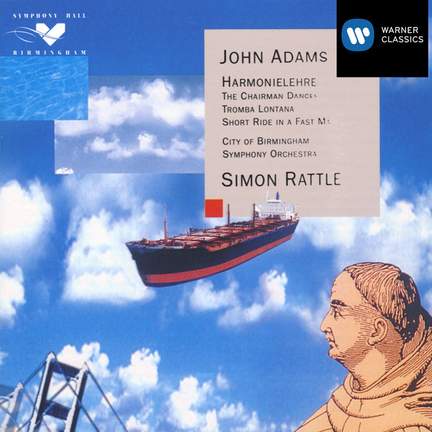
Harmonielehre was inspired by a dream vision of a massive tanker that suddenly took flight, displaying a 'beautiful brownish-orange oxide on the bottom part of its hull'; the setting was just...
Adams, J: Harmonielehre, etc.
City of Birmingham Symphony Orchestra, Simon Rattle
Purchase product
Harmonielehre was inspired by a dream vision of a massive tanker that suddenly took flight, displaying a 'beautiful brownish-orange oxide on the bottom part of its hull'; the setting was just...
About
Contents and tracklist
- City of Birmingham Symphony Orchestra
- Sir Simon Rattle
- Recorded: 1993-01-01
- Recording Venue: 4, 6, 8 & 9 July 1993, Symphony Hall, Birmingham
Part I
Track length17:29
This track is only available as an album download.
Part II - The Anfortas Wound
Track length12:26
This track is only available as an album download.
Part III - Meister Eckhardt and Quackie
Track length10:34
This track is only available as an album download.
- City of Birmingham Symphony Orchestra
- Sir Simon Rattle
- Recorded: 1993-01-01
- Recording Venue: 4, 6, 8 & 9 July 1993, Symphony Hall, Birmingham
- Wesley Warren (trumpet), Jonathan Holland (trumpet)
- City of Birmingham Symphony Orchestra
- Sir Simon Rattle
- Recorded: 1993-01-01
- Recording Venue: 4, 6, 8 & 9 July 1993, Symphony Hall, Birmingham
- City of Birmingham Symphony Orchestra
- Sir Simon Rattle
- Recorded: 1993-01-01
- Recording Venue: 4/6/8/9 September 1993, Symphony Hall, Birmingham
Awards and reviews
 2010
2010
Harmonielehre was inspired by a dream vision of a massive tanker that suddenly took flight, displaying a 'beautiful brownish-orange oxide on the bottom part of its hull'; the setting was just off San Francisco Bay Bridge. 'Those pounding E minor chords are like a grinding of gears,' says John Adams of its violent, gunshot opening.
Scored for a huge orchestra and structured in three contrasted sections, Harmonielehre is probably the nearest thing on offer to a minimalist symphony, and for that reason alone it could well appeal beyond the élite coterie of minimalist-fanciers.
Rattle's recording has great heft and dynamic range, an informative balance and a vivid sense of aural perspective. The brass components of those opening chords have enormous weight and presence, and the ringing marimbas thereafter a bright complexion. Adams's frequent requests for subtle tempo transitions are subtly honoured by the conductor.