Bizet: Carmen
Victoria de los Angeles (Carmen), Nicolai Gedda (Don José), Janine Micheau (Micaëla), Ernst Blanc (Escamillo), Denise Monteil (Frasquita), Monique Linval (Mercédès), Jean-Christoph Benoit (Le Dancaïre), Michel Hamel (Le Remendado), Bernard Plantey (Moralès), Xavier Depraz (Zuniga)
Choeurs,...
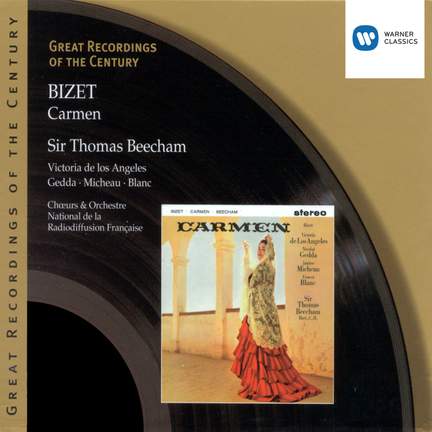
This classic Beecham set stands the test of time, sparkling, swaggering and seducing in a way that's uniquely Beecham's. It now comes in the EMI Great Recordings of the Century series, with...
Bizet: Carmen
Victoria de los Angeles (Carmen), Nicolai Gedda (Don José), Janine Micheau (Micaëla), Ernst Blanc (Escamillo), Denise Monteil (Frasquita), Monique Linval (Mercédès), Jean-Christoph Benoit (Le Dancaïre), Michel Hamel (Le Remendado), Bernard Plantey (Moralès), Xavier Depraz (Zuniga)
Choeurs,...
Purchase product
This classic Beecham set stands the test of time, sparkling, swaggering and seducing in a way that's uniquely Beecham's. It now comes in the EMI Great Recordings of the Century series, with...
About
Contents and tracklist
- René Alix (director), Bernard Plantey (baritone), Janine Micheau (soprano), Nicolai Gedda (tenor), Xavier Depraz (bass), Victoria de los Angeles (soprano), Monique Linval (soprano), Denise Monteil (soprano), Ernest Blanc (baritone), Michel Hamel (tenor), Jean-Christophe Benoit (baritone)
- Orchestre National de la Radiodiffusion-Télévision française, Maîtrise de la Radiodiffusion-Télévision française, Les Petits Chanteurs de Versailles, Choeurs de la Radiodiffusion-Télévision française
- Sir Thomas Beecham
Duo: Parle-moi de ma mère!
Track length10:27
This track is only available as an album download.
Récit & Air: C'est des contrabandiers le refuge ordinaire...Je dis, que rien ne m'épouvante
Track length6:20
Awards and reviews
 2010
2010
This classic Beecham set stands the test of time, sparkling, swaggering and seducing in a way that's uniquely Beecham's. It now comes in the EMI Great Recordings of the Century series, with brightened, freshened and clarified sound. As Richard Osborne points out in his brilliant, informative note, there were serious problems at the sessions – a second series was organised 15 months after the first (hence the two Mercédès) – but you would never realise there had been difficulties, either from the performance or the firmly focused, spacious recording in which the atmospheric off-stage effects are vividly caught.
What's so individual is the way that Beecham points rhythms to captivate the ear, as well as his persuasive moulding of phrases. Witness the sensuous way he coaxes the string phrase leading into the second half of the Don José/Micaëla duet in Act 2, 'Parle-moi de ma mère!' (disc 1, track 9, 3'47"). In those qualities Beecham is matched by Victoria de los Angeles in the titlerole.
Osborne reveals that Beecham's original choice of heroine was the Swedish mezzo Kerstin Meyer. After all, de los Angeles – Mimì in Beecham's Bohème recording – is hardly an obvious candidate for such a fire-eating role.
But there's far more to Carmen than is conveyed in that conventional approach, and de los Angeles instantly establishes her as a seductive, provocative character with wickedly sparkling eyes. In her opening solo, the Habanera, her delicious downward portamento on 'Je t'aime' is irresistible. The Carmen quality which de los Angeles doesn't have in her regular armoury, though, is a snarl. Instead she consistently uses her golden tone to tantalise and provoke, as in the magically sultry moment leading into 'Là-bas dans la montagne' in her Act 2 duet with José just after the Flower song (disc 2, track 13). At that point Beecham, too, subtly pressing the music forward, is a fellow magician. Then at the very end, in Act 4, de los Angeles does finally muster a snarl in the culminating phrase 'laisse-moi passer' ('Well stab me then, or let me pass').
In a way, Nicolai Gedda's portrait of Don José is just as remarkable. He was at his peak, and sings not just with refinement and imagination but with deep passion, leading you on in the widest expressive range in the Flower song.
Janine Micheau makes a bright, clear Micaëla, very French in tone, and Ernst Blanc, if not the most characterful Escamillo, makes the bullfighter a forthright, heroic character, singing with firm, clear tone.
The rest of the cast, all French, make an excellent team, as is clear in ensembles: the sparkling account of the Act 2 Quintet or the opening of the Card scene, or the swaggering march ensemble as the smugglers depart in Act 3 (disc 3, track 6). A magic set now made all the more enticing in this mid-price reissue.
 2011 edition
de los Angeles's portrayal of Carmen is absolteuyl bewitching, and when in the Quintet she says 'Je suis amoreuse' one believes her absolutely. Naturally the other singers are not nearly as dominant as this, but they make admirable foils...this famous set reasserts its position near the top of the list of recommendations