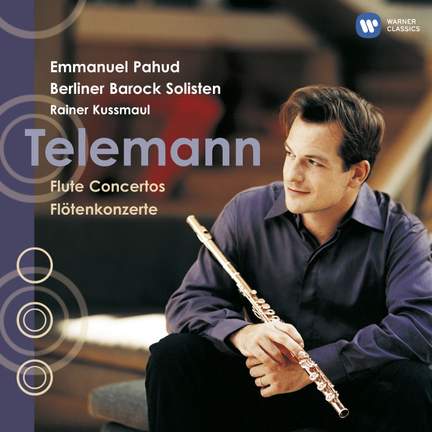
Telemann: Chamber Works
Emmanuel Pahud (flute)
Berlin Baroque Soloists
Awards:
-
Gramophone Magazine, December 2002, Editor's Choice

You'll rarely hear such personality in a Baroqueconcerto soloist as the extraordinary Emmanuel Pahud exhibits here. Berlin Baroque Soloists acclimatise effortlessly to an 18th-century palette,...
Telemann: Chamber Works
Emmanuel Pahud (flute)
Berlin Baroque Soloists
Purchase product
Awards:
-
Gramophone Magazine, December 2002, Editor's Choice
You'll rarely hear such personality in a Baroqueconcerto soloist as the extraordinary Emmanuel Pahud exhibits here. Berlin Baroque Soloists acclimatise effortlessly to an 18th-century palette,...
About
Contents and tracklist
- Emmanuel Pahud (flute)
- Berlin Barock Solisten
- Rainer Kußmaul
- Recorded: 2002-06-14
- Recording Venue: 8-9, 12-14 June 2002 RIAS Studio 10, Berlin
- Emmanuel Pahud (flute), Georg Faust (cello), Rainer Kußmaul (violin)
- Berlin Barock Solisten
- Rainer Kußmaul
- Recorded: 2002-06-14
- Recording Venue: 8-9, 12-14 June 2002 RIAS Studio 10, Berlin
- Emmanuel Pahud (flute), Jacques Zoon (flute), Klaus Stoll (violone)
- Berlin Barock Solisten
- Rainer Kußmaul
- Recorded: 2002-06-14
- Recording Venue: 8-9, 12-14 June 2002 RIAS Studio 10, Berlin
- Emmanuel Pahud (flute), Albrecht Mayer (oboe d'amore), Wolfram Christ (viola d'amore)
- Berlin Barock Solisten
- Rainer Kußmaul
- Recorded: 2002-06-14
- Recording Venue: 8-9, 12-14 June 2002 RIAS Studio 10, Berlin
- Emmanuel Pahud (flute)
- Berlin Barock Solisten
- Rainer Kußmaul
- Recorded: 2002-06-14
- Recording Venue: 8-9, 12-14 June 2002 RIAS Studio 10, Berlin
Awards and reviews
-
Gramophone MagazineDecember 2002Editor's Choice
 2010
2010
You'll rarely hear such personality in a Baroqueconcerto soloist as the extraordinary Emmanuel Pahud exhibits here. Berlin Baroque Soloists acclimatise effortlessly to an 18th-century palette, and distinguished colleagues they make for Pahud. The flautist sets out his stall from the Andante of the succinct G major concerto (completed from a damaged source and therefore making its recording début) whose startling resemblance to the slow movement of Bach's F minor Concerto, BWV1056, seems to inspire Pahud to a lyricism of understated elegance which one often hears in the best performances of the Bach work. Indeed, it's his sensitivity to Telemann's gestural implications and ability to colour the music at every turn which makes Pahud's playing so enchanting in all five concertos.
Telemann performance on a modern flute will inevitably lead to some recoiling, but one never feels deprived of the gentle and beguiling articulation of a 'period' instrument or its capacity for soft dynamic and purity of sound. One only has to hear the lithe performance of the A major Triple Concerto, from Part 1 of Telemann's famous banquet publication of 1733, Tafelmusik, where character abounds through Pahud's concern with first principles. Joyous exchange and textural delights abound in the Triple Concerto in E major, where Wolfram Christ's viola d'amore and Albrecht Mayer's oboe d'amore combine with the flautist in a ravishingly blended montage. The Flute Concerto in D confirms everything about Pahud's exquisite taste and mesmerising sound. A real winner.