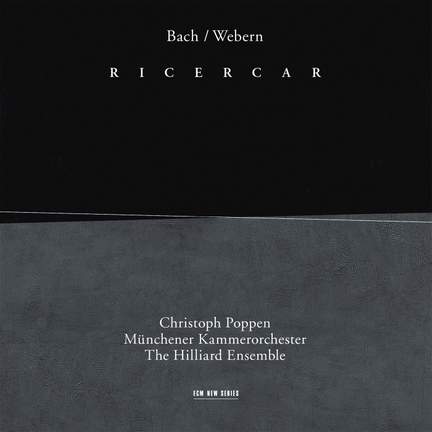
Bach/Webern Ricercar
Muenchener Kammerorchester & Hilliard Ensmble, Christoph Poppen
Awards:
-
Gramophone Magazine, July 2003, Editor's Choice

Symmetry, the cyclic evolution of a musical germ and the idea of birth in the midst of death: all are fundamental to this disc. Webern's motivically determined orchestration of the Ricercar...
Bach/Webern Ricercar
Muenchener Kammerorchester & Hilliard Ensmble, Christoph Poppen
Purchase product
Awards:
-
Gramophone Magazine, July 2003, Editor's Choice
Symmetry, the cyclic evolution of a musical germ and the idea of birth in the midst of death: all are fundamental to this disc. Webern's motivically determined orchestration of the Ricercar...
About
Contents and tracklist
- Munich Chamber Orchestra
- Christoph Poppen
- Recorded: 2001-01
- Recording Venue: Himmelfahrtskirche Sendling, München
- Munich Chamber Orchestra
- Christoph Poppen
- Recorded: 2001-01
- Recording Venue: Himmelfahrtskirche Sendling, München
- Monika Mauch (soprano), David James (countertenor), Rogers Covey-Crump (tenor), Gordon Jones (baritone)
- The Hilliard Ensemble, Munich Chamber Orchestra
- Christoph Poppen
- Recorded: 2001-01
- Recording Venue: Himmelfahrtskirche Sendling, München
- Munich Chamber Orchestra
- Christoph Poppen
- Recorded: 2001-01
- Recording Venue: Himmelfahrtskirche Sendling, München
- Munich Chamber Orchestra
- Christoph Poppen
- Recorded: 2001-01
- Recording Venue: Himmelfahrtskirche Sendling, München
Awards and reviews
-
Gramophone MagazineJuly 2003Editor's Choice
 2010
2010
Symmetry, the cyclic evolution of a musical germ and the idea of birth in the midst of death: all are fundamental to this disc. Webern's motivically determined orchestration of the Ricercar from Bach's late TheMusical Offering, where single lines change colour by the bar, opens and closes the programme.
Christoph Poppen's orchestration of Webern's 1905 String Quartet soars and surges with an ardour that befits this early but significant masterpiece.
Like Webern in Bach, Poppen knows how and where to taper his forces, while his players respond with obvious dedication. Bach's Cantata Christ lag in Todesbanden grows, as Herbert Glossner reminds us, from a 'primordial cell' of a single semitone motive. Eight stanzas each end with a 'Halleluja', as unalike in shade and meaning as the strands of Webern's 'Ricercar', so magnificent is the young Bach's handling of the texts. Poppen performs choral Bach with single voices; he also encourages a string playing style that largely dispenses with vibrato, so that when you cross from Webern's Quartet to Bach's BWV4 you could as well be switching to a period performance. The Hilliards sing beautifully, both solo and in ensemble, and the balance between voices and instruments is impeccable.
Some might balk at the sudden eruption of Webern's violent 'Heftig betwegt' on the heels of Bach's closing 'Halleluja', but the musical sense of having five 'symmetrical' Movements for String Quartet fall within the greater symmetry of the programme as a whole overrides any initial discomfort. Again, Poppen's finely tooled reading focuses in precise detail the mood and texture of each miniature so that the eventual return of Bach- Webern is indeed like a profound thought revisited by a changed mind.