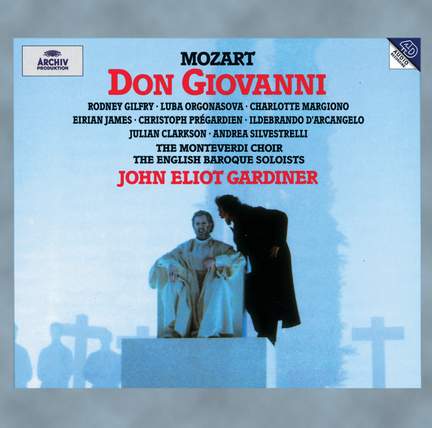
Mozart: Don Giovanni, K527
Rodney Gilfry (Don Giovanni), Luba Orgonasova (Anna), Charlotte Margiono (Elvira), Eirian James (Zerlina), Christoph Prégardien (Don Ottavio), Ildebrando d'Arcangelo (Leporello), Julian Clarkson (Masetto), Andrea Silvestrelli (Commendatore)
English Baroque Soloists, John Eliot Gardiner
Awards:
-
Building a Library, July 2018, Also recommended

Gardiner's set has a great deal to commend it.
The recitative is sung with exemplary care over pacing so that it sounds as it should, like heightened and vivid conversation, often to electrifying...
Mozart: Don Giovanni, K527
Rodney Gilfry (Don Giovanni), Luba Orgonasova (Anna), Charlotte Margiono (Elvira), Eirian James (Zerlina), Christoph Prégardien (Don Ottavio), Ildebrando d'Arcangelo (Leporello), Julian Clarkson (Masetto), Andrea Silvestrelli (Commendatore)
English Baroque Soloists, John Eliot Gardiner
Purchase product
Awards:
-
Building a Library, July 2018, Also recommended
Gardiner's set has a great deal to commend it.
The recitative is sung with exemplary care over pacing so that it sounds as it should, like heightened and vivid conversation, often to electrifying...
About
Contents and tracklist
- Charlotte Margiono (soprano), Eirian James (mezzo-soprano), Luba Orgonasova (soprano), Andrea Silvestrelli (bass), Christoph Prégardien (tenor), Julian Clarkson (bass), Rod Gilfry (baritone), Ildebrando D'Arcangelo (bass), Rod (Rodney) Gilfry (baritone)
- English Baroque Soloists, Monteverdi Choir
- Sir John Eliot Gardiner
- Recorded: 1994-07-07
- Recording Venue: Forum Am Schlosspark, Ludwigsburg
"Zitto! lascia ch'io senta" / "Ahi! ahi! la testa mia!" (Don Giovanni, Masetto / Masetto, Zerlina)
Track length2:11
"Dunque quello sei tu" - "Ah pietà... compassion" - "Ferma, perfido, ferma" (Zerlina, Donna Elvira, Don Ottavio, Masetto, Leporello)
Track length1:57
Awards and reviews
 2010
2010
Gardiner's set has a great deal to commend it.
The recitative is sung with exemplary care over pacing so that it sounds as it should, like heightened and vivid conversation, often to electrifying effect. Ensembles, the Act 1 quartet particularly, are also treated conversationally, as if one were overhearing four people giving their opinions on a situation in the street. The orchestra, perfectly balanced with the singers in a very immediate acoustic, supports them, as it were 'sings' with them. That contrasts with, and complements, Gardiner's expected ability to empathise with the demonic aspects of the score, as in Giovanni's drinking song and the final moments of Act 1, which fairly bristle with rhythmic energy without ever becoming rushed. The arrival of the statue at Giovanni's dinner-table is tremendous, the period trombones and timpani achieving an appropriately brusque, fearsome attack. Throughout this scene, Gardiner's penchant for sharp accents is wholly appropriate; elsewhere he's sometimes rather too insistent. As a whole, tempos not only seem right on their own account but also, all-importantly, carry conviction in relation to each other. Where so many conductors today are given to rushing 'Mi tradì', Gardiner prefers a more meditative approach, which allows his softgrained Elvira to make the most of the aria's expressive possibilities.
Rodney Gilfry's Giovanni is lithe, ebullient, keen to exert his sexual prowess; an obvious charmer, at times surprisingly tender yet with the iron will only just below the surface. Suave and appealing, delivered in a real baritone timbre, his Giovanni is as accomplished as any on disc. Ildebrando d'Arcangelo was the discovery of these performances: this young bass is a lively foil to his master and on his own a real showman, as 'Madamina' indicates, a number all the better for a brisk speed. Orgonasova once more reveals herself a paragon as regards steady tone and deft technique – there's no need here to slow down for the coloratura at the end of 'Non mi dir' – and she brings to her recounting of the attempted seduction a real feeling of immediacy. As Anna, Margiono sometimes sounds a shade stretched technically, but consoles us with the luminous, inward quality of her voice and her reading of the role, something innate that can't be learnt.
Nobody in their right senses is ever going to suggest that there's one, ideal version of DonGiovanni; the work has far too many facets for that, but for sheer theatrical élan complemented by the live recording, Gardiner is among the best, particularly given a recording that's wonderfully truthful and lifelike.

John Eliot Gardiner's set was recorded mainly live, and the result is vividly dramatic, beautifully paced and deeply expressive ... the performance culminates in one of the most thrilling accounts ever recorded of the final scene.