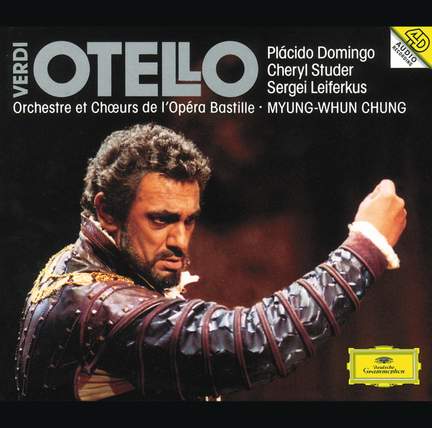
Verdi: Otello
Plácido Domingo (Otello), Cheryl Studer (Desdemona), Sergei Leiferkus (Iago), Ramón Vargas (Cassio), Michael Schade (Rodrigo), Ildebrando D'Arcangelo (Lodovico), Giacomo Prestia (Montano), Denyce Graves (Emilia)
Bastille Opera, Myung-Whun Chung
Awards:
-
Building a Library, January 2001, First Choice

theatre, so Otello is a difficult opera to bring off out of it. For some years now, Domingo has been, on stage, the greatest Otello of our age. On record, though, he has had less success. Leiferkus...
Verdi: Otello
Plácido Domingo (Otello), Cheryl Studer (Desdemona), Sergei Leiferkus (Iago), Ramón Vargas (Cassio), Michael Schade (Rodrigo), Ildebrando D'Arcangelo (Lodovico), Giacomo Prestia (Montano), Denyce Graves (Emilia)
Bastille Opera, Myung-Whun Chung
Purchase product
Awards:
-
Building a Library, January 2001, First Choice
theatre, so Otello is a difficult opera to bring off out of it. For some years now, Domingo has been, on stage, the greatest Otello of our age. On record, though, he has had less success. Leiferkus...
About
Contents and tracklist
- Philippe Duminy (bass), Plácido Domingo (tenor), Ramón Vargas (tenor), Ildebrando D'Arcangelo (bass), Francis Bardot, Cheryl Studer (soprano), Giacomo Prestia (bass), Denyce Graves (soprano), Michael Schade (tenor), Sergei Leiferkus (baritone), Denis Dubois (chorus master)
- Orchestre de l'Opéra Bastille, Choeurs de l'Opera Bastille, Maitrise Des Hauts De Seine
- Myung-Whun Chung
- Recorded: 1993-05-04
- Recording Venue: Opéra Bastille, Salle Gounod, Paris
Awards and reviews
 2010
2010
theatre, so Otello is a difficult opera to bring off out of it. For some years now, Domingo has been, on stage, the greatest Otello of our age. On record, though, he has had less success. Leiferkus and Domingo have worked closely together in the theatre; and it shows in scene after scene – nowhere more so than in the crucial sequence in Act 2 where Otello so rapidly ingests Iago's lethal poison. By bringing into the recording studio the feel and experience of a stage performance – meticulous study subtly modified by the improvised charge of the moment – both singers help defy the jinx that so often afflicts Otello on record. The skill of Leiferkus's performance is rooted in voice and technique: clear diction, a very disciplined rhythmic sense and a mastery of all ornament down to the most mordant of mordents.
Above all, he's always there (usually stage right in this recording), steely-voiced, rabbiting on obsessively. We even hear his crucial interventions in the great Act 3 concertato. Domingo is in superb voice; the sound seems golden as never before. Yet at the same time, it's a voice that's being more astutely deployed. To take that cruellest of all challenges to a studiobound Otello, the great Act 3 soliloquy 'Dio! mi potevi', Domingo's performance is now simpler, more inward, more intense. It helps that his voice has darkened, winning back some of its russet baritonal colourings.
Chung's conducting is almost disarmingly vital. Verdi's scoring is more Gallic than Germanic.
The score sounds very brilliant in the hands of the excellent Opéra-Bastille orchestra, and, in Act 4, very beautiful. Maybe Chung is wary of the emotional depths and, occasionally, the rhythmic infrastructure is muddled and unclear. And yet, the freshness is all gain. He's already a master of the big ensemble and the line of an act. Tension rarely slackens. On the rare occasions when it does, the mixing and matching of takes is probably to blame.
Studer's is a carefully drawn portrait of a chaste and sober-suited lady. Perhaps Verdi had a sweeter-voiced singer in mind for this paragon of 'goodness, resignation, and self-sacrifice' (Verdi's words, not Shakespeare's). Studer's oboe tones keep us at a certain distance, yet you'll look in vain for a better Desdemona. What's more, Studer is a singer who can single-mindedly focus the drama afresh, as she does more than once in Act 3. DG's recording is clear and unfussy and satisfyingly varied; Studer, in particular, is much helped by the beautifully open acoustic the engineers provide for the closing act. This is undoubtedly the best Otello on record since the early 1960s. It also happens to be the first time on disc that a great Otello at the height of his powers has been successfully caught in the context of a recording that can itself be generally considered worthy of the event, musically and technically.
 2010 edition
Domingo's third recording of Otello proves to be more freely expressive, even more involved than his previous ones; the baritonal quality of his tenor has here developed to bring extra darkness...Studer gives one of her finest performances as Desdemona...Chung is an urgent Verdian, adopting free-flowing speeds