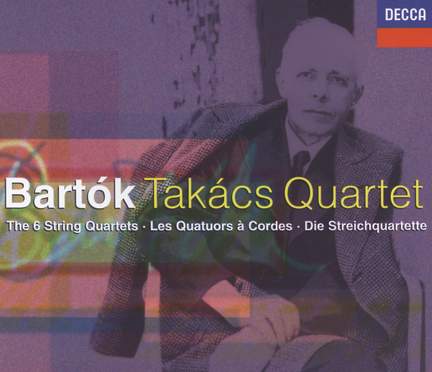
Bartók: String Quartets Nos. 1-6
Takács Quartet
Awards:
-
Building a Library, April 2002, First Choice

-
Building a Library, February 2021, Recommended Recording
These performances provide more impressive sampling points than can be enumerated in a single review. The First Quartet's oscillating tempo-shifts work wonderfully well, all with total naturalness....
Bartók: String Quartets Nos. 1-6
Takács Quartet
Purchase product
Awards:
-
Building a Library, April 2002, First Choice
-
Building a Library, February 2021, Recommended Recording
These performances provide more impressive sampling points than can be enumerated in a single review. The First Quartet's oscillating tempo-shifts work wonderfully well, all with total naturalness....
About
Contents and tracklist
- Roger Tapping (viola), Andras Fejér (cello), Károly Schranz (violin), Edward Dusinberre (violin)
- Takács Quartet
- Recorded: 1996-09-13
- Recording Venue: Reitstadel, Neumarkt
- Roger Tapping (viola), Andras Fejér (cello), Károly Schranz (violin), Edward Dusinberre (violin)
- Takács Quartet
- Recorded: 1996-09-13
- Recording Venue: Reitstadel, Neumarkt
- Roger Tapping (viola), Andras Fejér (cello), Károly Schranz (violin), Edward Dusinberre (violin)
- Takács Quartet
- Recorded: 1996-09-13
- Recording Venue: Reitstadel, Neumarkt
- Roger Tapping (viola), Andras Fejér (cello), Károly Schranz (violin), Edward Dusinberre (violin)
- Takács Quartet
- Recorded: 1996-09-13
- Recording Venue: Reitstadel, Neumarkt
- Roger Tapping (viola), Andras Fejér (cello), Károly Schranz (violin), Edward Dusinberre (violin)
- Takács Quartet
- Recorded: 1996-09-13
- Recording Venue: Reitstadel, Neumarkt
- Roger Tapping (viola), Andras Fejér (cello), Károly Schranz (violin), Edward Dusinberre (violin)
- Takács Quartet
- Recorded: 1996-09-13
- Recording Venue: Reitstadel, Neumarkt
Awards and reviews
 2010
2010
These performances provide more impressive sampling points than can be enumerated in a single review. The First Quartet's oscillating tempo-shifts work wonderfully well, all with total naturalness.
Characterisation is equally strong elsewhere, not least the first movement of the Debussian arpeggios of the Second Quartet, and the second movement where Fejér races back into the rustic opening subject. The nightmare climax in the last movement has rarely sounded more prophetic of the great Divertimento's central movement. The middle quartets work very well, with prominent inner voices in the Third and plenty of swagger in the Fourth. The high spots of No 4 are Fejér's improvisational cello solo in the third movement and a finale where the violent opening is a hefty legato to compare with the sharper, more Stravinskian attack of, say, the Tokyo Quartet. Likewise, the sudden dance-like episode in the first movement of the Fifth Quartet, savage music played from the pit of the stomach, while the third movement's bleary-eyed viola melody over teeming violin triplets suggests peasants in caricature.
The Takács are responsive to Bartók's sardonic humour – the 'barrel-organ' episode at the end of the Fifth Quartet, and the corny 'Burletta' in the third movement of the Sixth. The Sixth itself has some of the saddest, wildest and wisest music written in the last 100 years: the opening viola solo recalls Mahler's Tenth and the close fades to a mysterious question.
Throughout the cycle, Bartók's metronome markings are treated more as guidelines than literal commands. The playing imparts Bartók's all-embracing humanity. If the greatest string quartets after Beethoven are still unknown to you, this set may well prove the musical journey of a lifetime. The recording has ambient, fullbodied sound that's more reminiscent of the concert hall than the studio.