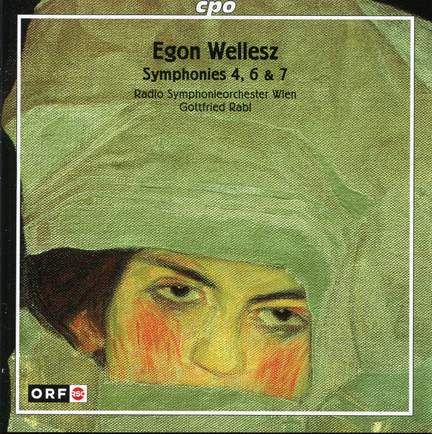
Wellesz: Symphonies Nos. 4, 6 & 7
Radio Symphonieorchester Wien, Gottfried Rabl
Like his near-contemporaries Ernst Toch and Havergal Brian, Wellesz came late to the symphony, composing his first (1945), inspired by memories of Austria, at the age of 60. No 4 (1951-53) had...
Wellesz: Symphonies Nos. 4, 6 & 7
Radio Symphonieorchester Wien, Gottfried Rabl
Purchase product
Like his near-contemporaries Ernst Toch and Havergal Brian, Wellesz came late to the symphony, composing his first (1945), inspired by memories of Austria, at the age of 60. No 4 (1951-53) had...
About
Egon Wellesz's name comes up together with Schönberg, Berg, and Webern when the Viennese school of the early twentieth century is the topic, even though he very early left behind the environment created by such twelve-toners in quest of his own harmonic paths. Born in Vienna, Wellesz was one of Schönberg's first pupils and a musicology student under Guido Adler, with his training in both disciplines turning out to be of use to him later in life. Until the outbreak of World War II he was one of the most-performed composers in German-speaking Europe, and his five operas were successfully premiered at the leading German houses. At the time he was also a professor of musicology specializing in the decipherment of Byzantine notation. Then things fell apart. He was forced into emigration in England in 1938 but was able to continue his university career in Oxford. Wellesz the composer remained silent until the end of the war, when he first regained his full creative powers and then went on to compose almost half of his oeuvre after his sixtieth birthday. His nine symphonies are without a doubt the main works of this late period. The emigrant very deliberately drew on Austrian symphonic music, with his symphonies involving, among other things, an effort to come to terms with his loss of his home.
Contents and tracklist
- Radio-Symphonieorchester Wien
- Gottfried Rabl
- Radio-Symphonieorchester Wien
- Gottfried Rabl
- Radio-Symphonieorchester Wien
- Gottfried Rabl
Awards and reviews
 2010
2010
Like his near-contemporaries Ernst Toch and Havergal Brian, Wellesz came late to the symphony, composing his first (1945), inspired by memories of Austria, at the age of 60. No 4 (1951-53) had similar inspiration and bears the soubriquet Sinfonia Austriaca. Although Wellesz used atonality or serialism throughout his life, he also used tonality if he felt it appropriate, mixing the disciplines as his expressive purposes demanded. No 4 is a case in point, essentially a pastoral (albeit vigorously so) tonal symphony employing varying degrees of 'free tonality' throughout, especially in the intense Adagio.
Wellesz's later symphonies employ a slowfast- slow design, the slow outer spans tending to be varied in pulse, encasing vigorous central scherzi. No 6 (1965) is perhaps his best known, having been broadcast a few times over the years. A riveting work, it's one of his finest utterances, showcasing his mastery of symphonic cogency, formal construction and orchestration.
As in the late symphonies of Vaughan Williams, Wellesz was constantly refining and exploring his sound world: if the harmonic language of the Fourth is the most accessible to general listeners, the orchestration of the terser Seventh (1967) makes the earlier work seem pallid by comparison. Very strongly recommended.