Anne Sofie von Otter sings Sibelius
Anne Sofie von Otter (mezzo-soprano), Bengt Forsberg (piano), with Monica Groop (mezzo-soprano)
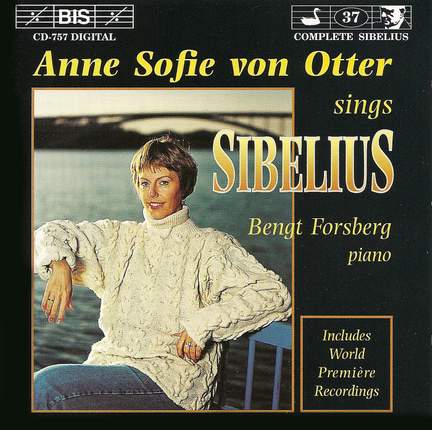
The vast majority of Sibelius's songs are in Swedish, the language with which he grew up as a child, and here they're given by a distinguished native Swedish partnership. The Seven Songs, Op...
Anne Sofie von Otter sings Sibelius
Anne Sofie von Otter (mezzo-soprano), Bengt Forsberg (piano), with Monica Groop (mezzo-soprano)
Purchase product
The vast majority of Sibelius's songs are in Swedish, the language with which he grew up as a child, and here they're given by a distinguished native Swedish partnership. The Seven Songs, Op...
About
Contents and tracklist
Work length20:48
No. 1, Under strandens granar
Track length5:30
No. 2, Kyssens hopp
Track length2:14
No. 3, Hjärtats morgon
Track length2:35
No. 4, Våren flyktar hastigt
Track length1:38
No. 5, Drömmen
Track length1:48
No. 6, Till Frigga
Track length4:04
No. 7, Jägargossen
Track length2:59
Work length14:34
No. 1, Lenzgesang
Track length2:28
No. 2, Sehnsucht
Track length2:00
No. 3, Im Feld ein Mädchen singt
Track length3:04
No. 4, Aus banger Brust
Track length2:25
No. 5, Die stille Stadt
Track length2:47
No. 6, Rosenlied
Track length1:50
Work length13:56
No. 1, Norden
Track length2:11
No. 2, Hennes budskap
Track length1:36
No. 3, Morgonen
Track length2:30
No. 4, Fågelfängaren
Track length1:31
No. 5, Sommarnatten
Track length2:53
No. 6, Vem styrde hit din väg?
Track length3:15
Sibelius:
Skogsrået, JS 171
Work length6:47
Sibelius:
Belsazars gästabud, JS 48
Work length3:00
No. 2b, Solitude (Den judiska flickans sång)
Track length3:00
Sibelius:
Likhet, JS 120
Work length1:47
Sibelius:
En visa, JS 71
Work length1:30
Sibelius:
Tanken, JS 192
Work length1:36
Awards and reviews
 2010
2010
The vast majority of Sibelius's songs are in Swedish, the language with which he grew up as a child, and here they're given by a distinguished native Swedish partnership. The Seven Songs, Op 13, are all Runeberg settings and come from the composer's early years (1891-2). Best known, perhaps, are 'Spring is flying' and 'The dream', but there are others, such as 'The young hunter', that are no less delightful and characterful.
The other Runeberg settings here, the Six Songs, Op 90, come towards the end of Sibelius's career as a song composer (1917-18). 'The north', as in all the nature poetry of Runeberg, touches a very special vein of inspiration. Along with 'Die stille Nacht', Op 50 No 5, which is equally affectingly given by these two artists – it's among his finest songs. Interest naturally focuses on the rarities.
The Wood Nymph, not to be confused with the melodrama or the tone-poem, is recorded here for the first time. As well as A Song, there are two other early Runeberg settings, the 1888 Serenade and Resemblance, both of them also premiere recordings. 'The Jewish Girl's Song' will be familiar from the incidental music to Belshazzar'sFeast, and is affecting in this form – particularly sung as it is here. Given the artistry and insight of this splendid partnership, and the interest and beauty of the repertoire, this is a self-recommending issue.