Haydn: String Quartets Op. 54
The Lindsays
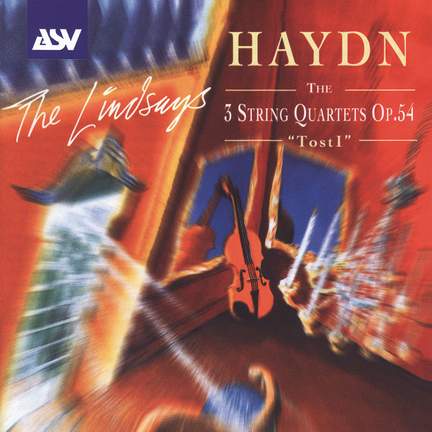
All three quartets are in the usual fourmovement form but they contain many surprises: in No 1, the false recapitulation in the first movement, the dark modulations in the following sonata-form...
Haydn: String Quartets Op. 54
The Lindsays
Purchase product
All three quartets are in the usual fourmovement form but they contain many surprises: in No 1, the false recapitulation in the first movement, the dark modulations in the following sonata-form...
About
Contents and tracklist
Work length19:11
- Peter Cropper (violin), Ronald Birks (violin), Robin Ireland (viola), Bernard Gregor-Smith (cello)
- Lindsay String Quartet
- Recorded: 1987-01
- Recording Venue: Kirklees Hall, West Yorkshire
1. Allegro con brio
Track length5:15
2. Allegretto
Track length6:27
3. Menuetto (Allegretto)
Track length3:55
4. Finale (Presto)
Track length3:34
Work length21:19
- Peter Cropper (violin), Ronald Birks (violin), Robin Ireland (viola), Bernard Gregor-Smith (cello)
- Lindsay String Quartet
- Recorded: 1987-01
- Recording Venue: Kirklees Hall, West Yorkshire
1. Vivace
Track length6:04
2. Adagio - 3. Menuetto
Track length6:56
4. Finale (Adagio - presto)
Track length8:19
Work length23:19
- Peter Cropper (violin), Ronald Birks (violin), Robin Ireland (viola), Bernard Gregor-Smith (cello)
- Lindsay String Quartet
- Recorded: 1987-01
- Recording Venue: Kirklees Hall, West Yorkshire
1. Allegro
Track length6:19
2. Largo cantabile
Track length9:18
3. Menuetto (Allegretto)
Track length3:28
4. Finale (Presto)
Track length4:14
Awards and reviews
 2010
2010
All three quartets are in the usual fourmovement form but they contain many surprises: in No 1, the false recapitulation in the first movement, the dark modulations in the following sonata-form Allegretto and the Hungarian gipsy flavour (anticipated in the Minuet) and mischievousness of the final rondo. No 2 has a rhapsodic fiddler in its second movement, a nostalgic minuet with an extraordinarily anguished trio, and an Adagio finale in which a Presto section turns out to be no more than an episode.
A notable feature of No 3 is its ternary-form Largo cantabile, the centre of which is more like a mini-concerto for the first violin; 'Scotch snaps' pervade the Minuet, and pedal points the finale.
The performances and the recording are superb, marked by unanimity, fine tone, suppleness of phrasing, and acute dynamic shaping; in the second movement of No 1 there are hushed passages whose homogeneity and quality of sound are both quite remarkable. Overall, this recording is irresistible.