Samantha spoke to me last month about the two women's remarkable stories and individual styles, the contrasts between their approaches to writing for the piano, and the rewards and challenges of balancing a career which incorporates academic research and teaching as well as an increasingly busy performance-schedule...
When and how did Julia Perry come onto your radar?
I’d known her name for a long time before I really got to know her music. When I was learning about Black women composers like Florence Price and Margaret Bonds as a student, I came across resources that would point me towards Julia Perry. But until recently the only piano work of hers that I’d heard was the short Prelude, which is just one page of music: it’s so concentrated, and you really have to spend time with it in order to understand what she’s doing. Margaret Bonds and Florence Price are more easily accessible because they draw you in with these wonderful melodies, but Perry makes you work a lot harder!
Much of my own research has focused on women composers in Chicago, and the city is very much a part of Perry’s story: she travelled a lot in the US as well as in further afield, and when you go down that rabbit-hole you discover all sorts of connections between these women. I found a fantastic photo of Julia Perry which was taken by Irene Britton Smith, a Chicago-based composer who was a big fan of Florence Price - she actually wrote to Price and got a very encouraging response but was too shy to introduce herself in person! But her music is actually closer to Julia Perry’s in terms of the soundworld, as it's quite spare and neoclassical.
Although Perry's voice is very individual, I heard a certain kinship with Copland in some passages of the Piano Concerto - did they have any contact?
She was actually friends with Copland: they both worked with Nadia Boulanger and were part of the same scene, so if you hear those influences then it’s because she was quite literally at the heart of American modernism. I recently came across some very cool footage where he’s interviewing her about what she’s working on, and there’s a real rapport between them: she’s being very jokey and sarcastic, and they’re obviously comfortable enough with each other for her to laugh at his questions!
How much did Perry and her music travel beyond America?
She was far more cosmopolitan than the composers of the Florence Price generation, who tended to go in for a more traditional nineteenth-century German sound. Perry had the opportunity to travel much more widely and absorb more international influences: she spent time at Tanglewood and in Paris and Italy, soaking up everything around her. I get the sense that she was really in her element in Italy - she spoke the language fluently, and the locals would call her ‘Maestra’ (hence the title of the album). I found that so powerful, because it shows that she was defined by her musicality there; back in the United States the Jim Crow segregation laws wouldn’t necessarily have allowed her that kind of status and freedom, but in Italy it was a different story.
The title is also a nod to the film Maestro because there’s a dropped connection with Leonard Bernstein, who was a great champion of Black performers and composers and was certainly aware of Perry's work. We know she sent him quite a few of her scores, but somehow the stars didn’t align and they never got to meet…That’s one of those ‘What if?’ moments that we come across so often as historians: if Bernstein had programmed some of her music we’d probably be having a very different conversation about her today…
How do the two composers on the album differ in terms of their approach to writing for the piano?
Perry’s writing can be very sparse, in ways that are sometimes scarier than more virtuosic stuff: it requires so much space and delicacy. I remember some of the orchestral players describing the concerto as being more than the sum of its parts, and that’s so true - especially in that opening movement where different atmospheric layers are dancing around and seeping in. It’s quite a dramatic effect, and I feel that we are working towards shaping the colours together rather than me taking centre-stage as a soloist.
In contrast, Doreen Carwithen’s concerto has several really fast mechanical passages where you can throw everything you’ve got at the instrument. I did it in Oakland last year with the conductor Kalena Bovell, and I remember her asking: ‘How will you cue that massive glissando?’ I told her I’d just hurl myself at the piano! You can’t do that with those subtler moments in the Perry.
Doreen Carwithen had a very prolific career as a composer of film music - do you hear any cinematic qualities in her concerto?
Absolutely: even though it predates her film work it’s already clear that she’s got her own identity, and it’s very narrative-driven. The first time I heard this piece was quite a few years ago, and its urgency spoke to me very directly: I knew I had to play it at some point. There would be times where I’d wake up in the middle of the night and hear it in my head - on one memorable occasion during a thunderstorm, which was pretty dramatic!
A lot of what I know about Carwithen’s life comes from her biographer Leah Broad. It’s been wonderful to be able to talk to Leah as I’m working on this repertoire, and to read as a music-lover rather than a historian - I think it brings a different edge to the performance. The most obvious influence is her teacher William Alwyn, whom she married in 1975. I hear his voice in her music, but I also hear her voice in his - perhaps even more so, although maybe that’s just because I’ve spent more time with her work.
Did I detect occasional echoes of Rachmaninoff in there too...?
There is some of that, but luckily not too much because my hands are quite small! I’ve worked with conductors who hear Prokofiev’s influence as well – there are some spiky toccata-like moments where I can see that, but her own individual voice comes across so powerfully. She has certain signature gestures, but they’re always contextualised within the story she wants to tell. It’s not a fireworks piece in the sense of ‘Look at all these tricks that I can do’ – there’s a real sense of intent as to why these moments are surfacing in the music, so it’s no surprise that she went on to have a significant career in film music.
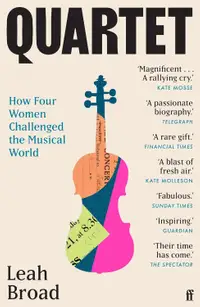
You mentioned Leah Broad, whose 2023 book Quartet does a wonderful job of telling Carwithen's story - are there any similar resources you’d recommend to those who’d like to explore Perry’s life and work in more detail?
The closest thing we have to a Julia Perry biography is Helen Walker-Hill’s book From Spirituals To Symphonies: African American Women Composers and their Music from 2007. Last year I did an article with the musicologist Garrett Schumann for I Care If You Listen to mark the centenary of Perry's birth, which tied in a series of events in New York, Manchester, and St. Louis Missouri. As well as discussing her life and legacy, I also talked about the challenges of raising the funds for a project like this (which are quite considerable when you’re not a mainstream name).
Perry wrote a lot of symphonic music, and it would be wonderful if more orchestras would take it on: it really deserves to be engaged with alongside other composers of that era, because what she’s doing is so unique. A lot of Doreen Carwithen’s music is already out there: Faber is publishing more of her instrumental works, and I’d encourage musicians (pianists especially!) to explore it because it’s so exciting to hear different takes. Mine is the third recording of the concerto; making space for multiple interpretations is an important part of building the legacy of a composer, so I hope other potential performers don’t think ‘Oh, that’s done and dusted now so I won’t bother playing or recording it myself!’.
Alongside your busy concert-schedule, you're also a distinguished musicologist: how is the balance between performing and research for you at the moment?
I’m at Southampton University on a research fellowship which is coming to an end shortly, so it’s interesting to think about what the next few years will look like as my job perhaps entails taking on more academic responsibilities. The performance side of my career has really taken on a life of its own and become bigger than I ever could have imagined, but I feel like I’ve struck a good balance because I’m not trying to do too many things and be too many things to so many different people.
Because I’m primarily a music historian, I have a certain amount of freedom in terms of what I programme and record: although obviously I want as many people as possible to hear this music, there isn’t the same financial pressure to do really well in a commercial sense and focus on charting and streaming-stats above all else. The music of the canon has never been my bread-and-butter. As a performer my real motivation is ‘What inspires me? What are the stories that I want to tell, and what stories can I tell?’. I know the stories behind the repertoire I’m playing and I know why it’s important for me to play it, and that puts me in a strong position to advocate for the music.
In terms of recordings, the next thing will be an album of music by Avril Coleridge-Taylor with the wonderful John Andrews and the BBC Philharmonic: that’s already in the can, and will be appearing on Resonus in the near future…
Please note: Lorelt Recordings are currently only available in CD format, though downloads and streaming are coming soon!

Samantha Ege (piano), Lontano Orchestra, Odaline de la Martinez
Available Formats: CD, FLAC/ALAC/WAV, MP3

Samantha Ege
Available Format: Book

Helen Walker-Hill
Available Format: Book
Leah Broad
Available Format: Book

Samantha Ege (piano)
Available Formats: CD, FLAC/ALAC/WAV, MP3

Samantha Ege (piano), Castle of Our Skins
Available Formats: CD, FLAC/ALAC/WAV, MP3