Defining Deutschtum: Political Ideology, German Identity, and Music-Critical Discourse in Liberal Vienna
- Author: Brodbeck, David
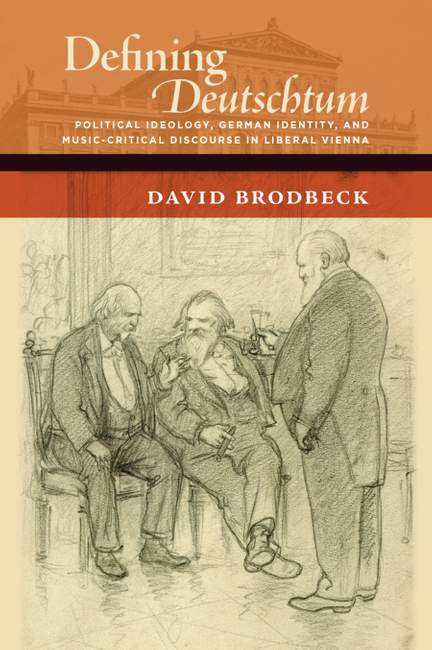
Throughout the convoluted twists and turns of this story, Brodbeck is always a clear and patient guide. The sheer density of detail might easily have become bewildering, but what emerges is...
Defining Deutschtum: Political Ideology, German Identity, and Music-Critical Discourse in Liberal Vienna
- Author: Brodbeck, David
Purchase product
Throughout the convoluted twists and turns of this story, Brodbeck is always a clear and patient guide. The sheer density of detail might easily have become bewildering, but what emerges is...
About
This is an open access title. It is available to read and download as a free PDF version on Oxford Academic and is made available under a Creative Commons Attribution 4.0 International licence. Defining Deutschtum: Political Ideology, German Identity, and Music-Critical Discourse in Liberal Vienna offers a nuanced look at the intersection of music, cultural identity, and political ideology in late-nineteenth-century Vienna. Drawing on an extensive selection of writings in the city's political press, correspondence, archival documents, and a large body of recent scholarship in late Habsburg cultural and political history, author David Brodbeck argues that Vienna's music critics were important agents in the public sphere whose writings gave voice to distinct, sometimes competing ideological positions. These conflicting positions are exemplified especially well in their critical writings about the music of three notable composers of the day who were Austrian citizens but not ethnic Germans: Carl G
Contents
- CONTENTS
- List of Plates
- Preface and Acknowledgments
- Note on Place Names and Orthography
- Introduction Viennese Critics and the Habsburg Dilemma
- From the Vormarz to the Liberal Heyday
- Chapter 1 Hanslick's Deutschtum
- Chapter 2 Becoming a German: Goldmark and the Assimilationist Project
- Chapter 3 Liberal Essentialism and Goldmark's Early Reception
- Chapter 4 Rethinking the Billroth Affair
- Plates
- From the Iron Ring to the Fin de siecle
- Chapter 5 Language Ordinances, National Property, and Dvo?ak's Reception in the Taaffe Era
- Chapter 6 Goldmark's Reception Revisited: Liberal Accreditation and Antisemitic Attack
- Chapter 7 Politics Makes Strange Bedfellows
- or, Smetana's Reception in the 1890s
- Chapter 8 Goldmark's Deutschtum Revisited
- Epilogue Germans, Jews, and Czechs in Mahler's Vienna
- Bibliography
- Index
Awards and reviews

Throughout the convoluted twists and turns of this story, Brodbeck is always a clear and patient guide. The sheer density of detail might easily have become bewildering, but what emerges is a remarkably clear and finely drawn account. This is an impressive work of scholarship that reconstructs not only a musical but also a cultural and political history ... Brodbeck's analysis of how political tensions find an ideal areana in seemingly trivial disputes is both powerful and timely