Method for the One-Keyed Flute
- Author: Boland, Janice Dockendorff
Method for the One-Keyed Flute
- Author: Boland, Janice Dockendorff
Purchase product
About
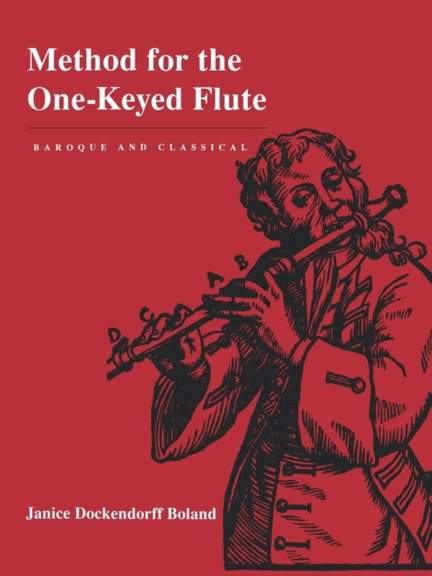
This indispensable manual for present-day players of the one-keyed flute is the first complete method written in modern times. Janice Dockendorff Boland has compiled a manual that can serve as a self-guiding tutor or as a text for a student working with a teacher. Referencing important eighteenth-century sources while also incorporating modern experience, the book includes nearly 100 pages of music drawn from early treatises along with solo flute literature and instructional text and fingering charts. Boland also addresses topics ranging from the basics of choosing a flute and assembling it to more advanced concepts such as tone color and eighteenth-century articulation patterns.
Contents
- PREFACE
- ACKNOWLEDGMENTS
- CHAPTER I ABOUT THE ONE-KEYED FLUTE
- On the Flute
- A bit of history
- Names
- Materials used
- Range
- Concerning the highest notes
- On the Parts of the Flute
- Three-piece flute
- Four-piece flute
- The tenon
- The cork
- The screw cap
- The foot register
- On Pitch
- Modern replicas
- Corps de rechange
- On Choosing a Flute
- Pitch
- Style
- Woods
- Used flutes
- On Care
- Checklist
- Oiling the flute
- CHAPTER II LEARNING TO PLAY THE ONE-KEYED FLUTE
- On Getting Started
- How to proceed
- Assembly
- On Holding the Flute
- Physical problems
- Left hand
- Right hand
- Checklist
- An interesting side line
- On Tone
- Checklist
- Embouchure
- Amusing side line
- CHAPTER III On Homogeneity of Sound (Tone Color Tendencies)
- Strong notes
- Weak notes
- Changes at century's end
- On Key (Tonality)
- On Vibrato
- The flattement
- How is the flattement executed?
- How is the flattement used?
- The flattement with the messa di voce
- Notation
- Are we certain that breath vibrato was not used?
- Recommended readings
- On Intonation
- How to tune
- Playing "in tune"
- Enharmonic notes
- Practical application
- Practicing good intonation
- Adjusting for intonation
- On Playing Forte and Piano
- Using the screw cap
- On Rhythmic Hierarchy
- "Good" notes, "bad" notes
- Practical application
- Quick notes
- Beating time
- Recommended readings
- On Articulation
- Articulation silences
- Unslurred notes
- Eighteenth-century patterns for quick notes
- Double tonguing
- Recommended readings
- On Further Readings
- CHAPTER III FINGERINGS FOR THE ONE-KEYED FLUTE
- On Fingerings
- Why so many choices?
- Lowering the pitch
- Use of the key
- Extending the range
- Alternate f sharp
- How many fingerings?
- On Trills
- Wide Trills
- Execution
- Recommended readings
- Explanation of the Charts
- Basic Fingering Chart
- Complete Fingering Chart
- Table of Trills
- Flattement Chart
- CHAPTER IV EXERCISES AND TUNES TO PLAY
- About the Music
- Duet playing
- Exercises and Tunes (Eighteenth-Century Sources)
- D Major
- G Major
- e mmor
- A Major
- CHAPTER V MODERN STUDIES FOR ONE-KEYED FLUTE
- Introduction to Modern Studies
- Practice Routine
- Modern Exercises
- Major sequences for the one-keyed flute
- Broken chord studies in the major keys
- Broken chord studies in minor keys
- APPENDIX A THE "TOP 13" EIGHTEENTH-CENTURY FLUTE TUTORS
- APPENDIX B ON REPERTOIRE FOR THE
- BEGINNING ONE-KEYED FLUTIST
- Easy solos
- Collections
- Studies
- Easy Duets
- ANNOTATED BIBLIOGRAPHY: BEFORE 1853
- AFTER 1853